A property can have the heating switched on and still feel uncomfortable, with cold walls, condensation around windows or certain rooms that never seem to warm up properly. In summer, the opposite can happen: particular areas of the building envelope heat up quickly and make indoor temperatures harder to control.
One possible cause is the presence of thermal bridges: specific parts of the building envelope where heat passes through more easily than through the surrounding construction.
This is particularly relevant in Madrid, where homes and commercial properties need to cope with cold winter periods as well as very hot summer conditions. However, a cold wall or a damp mark does not automatically mean that a thermal bridge is present. Before deciding on repairs, it is important to distinguish between insulation problems, condensation, water ingress, air leakage and other possible causes.
This guide explains thermal bridges in practical terms for homeowners, landlords and property investors in Madrid, including what to look for before buying, renovating or rehabilitating a property.
What is a thermal bridge?
A thermal bridge is an area of a building envelope where resistance to heat flow is lower than in the surrounding construction.
In simple terms, imagine an external wall that is insulated across most of its surface. If the insulation is interrupted, becomes thinner or is crossed by a material that transfers heat more readily, heat can find an easier route through that point.
This often occurs where different building elements meet: for example, where a concrete structural column intersects an external wall, where a floor slab meets the façade or around the perimeter of a window.
Spain’s Technical Building Code (Código Técnico de la Edificación, or CTE) addresses the thermal performance of buildings and recognises junctions such as structural elements, window openings, floor edges and roof-to-wall connections as relevant areas when assessing thermal bridges.
The issue is not limited to energy transfer. During winter, a thermal bridge can also lower the temperature of an internal surface. If the indoor humidity is high enough, that colder surface may become more susceptible to condensation.
Where do thermal bridges commonly occur?
A building is made up of many different materials and construction systems. Thermal bridges frequently develop where those systems connect.
- Structural columns within external walls: particularly where the structural element interrupts the insulation layer.
- Floor slab edges: where each floor meets the external façade.
- External corners: building geometry itself can affect heat flow and internal surface temperatures.
- Around windows and external doors: including lintels, reveals, sills and the junction between the frame and the wall.
- Roller-shutter boxes: a common feature in Madrid homes, particularly in older properties where insulation may be limited.
- Balconies and structural cantilevers: especially where a continuous structural element extends from the interior to the exterior.
- Roof-to-wall junctions: particularly relevant in penthouses and detached houses.
- Transitions between different construction systems: for example, where a renovated section meets an older part of the building envelope.
Main types of thermal bridges
Thermal bridges caused by materials
These occur when a material with different thermal properties interrupts an otherwise more insulating part of the building envelope.
A typical example is a concrete column crossing an external wall that contains insulation. The structural element may transfer heat differently from the surrounding wall construction.
Thermal bridges caused by geometry
A change of material is not always necessary. Corners, wall junctions and roof connections can concentrate heat flow simply because of their geometry.
This can result in internal surface temperatures that differ from the surrounding wall.
Thermal bridges caused by construction discontinuities
A technically sound design can still perform poorly if insulation is installed with gaps, interruptions or badly resolved junctions.
For that reason, correcting a thermal bridge is not simply a matter of adding more insulation. The first task is to understand where the thermal continuity has been interrupted and why.
Warning signs that may indicate a thermal bridge
Several symptoms may justify further investigation, although none provides a definitive diagnosis on its own.
- Walls, corners or structural elements that feel noticeably colder than nearby surfaces.
- Recurring condensation in the same locations.
- Mould around corners, columns, lintels or window surrounds.
- Marks that mainly appear during colder months.
- Cold surfaces around roller-shutter boxes.
- Noticeable temperature differences between rooms.
- Difficulty maintaining comfortable indoor conditions.
- Higher-than-expected heating or cooling requirements.
These symptoms may also have other causes. Draughts, poorly sealed windows, insufficient insulation, ventilation problems and heating-system performance can all affect comfort.
For a broader seasonal inspection, see our guide to home maintenance after summer in Madrid, which covers windows, damp, ventilation and climate-control issues before winter.
Thermal bridge, condensation and water ingress: what is the difference?
This distinction matters because the repair strategy can be completely different in each case.
Condensation
Condensation occurs when water vapour in the indoor air meets a surface that is cold enough for moisture to condense on it.
A thermal bridge can lower the internal surface temperature and therefore increase the risk of condensation when indoor humidity is sufficiently high.
The thermal bridge itself is not water entering the property. It is a thermal condition that can make a surface more vulnerable to condensation.
Water ingress and leaks
Water ingress involves liquid water entering through a roof, terrace, façade, construction joint, window perimeter, plumbing system or another part of the building.
A damp patch caused by water ingress can sometimes look similar to condensation, but the underlying repair is entirely different.
For this reason, covering a mark with paint or installing insulation without identifying the source may hide the visible symptom without solving the actual problem.
Can several problems occur at the same time?
Yes. A Madrid property may have a thermal bridge, excessive indoor humidity and a localised leak simultaneously.
This is why diagnosis should normally consider the building envelope, ventilation, weather exposure, plumbing and the pattern of the damp or condensation together rather than treating a visible mark in isolation.
How thermal bridges can affect a property
The effect of a thermal bridge depends on its location, size, severity and the overall construction of the building.
Possible consequences include:
- increased heat transfer between the interior and exterior;
- reduced thermal comfort close to affected surfaces;
- a greater risk of surface condensation under certain conditions;
- mould growth where cold surfaces and sufficient moisture occur together;
- deterioration of paint and finishes where moisture repeatedly develops;
- poorer overall energy performance of the building envelope.
Can thermal bridges affect property value?
For an owner or investor, thermal performance is not only a construction issue.
A property with recurring mould, visible damp marks, uncomfortable cold surfaces or persistent temperature differences may be less attractive to potential buyers or tenants, particularly if the cause has not been properly identified.
However, there is no reliable universal percentage by which a thermal bridge reduces or increases property value. Its impact depends on the extent of the defect, the condition of the property as a whole, the cost and complexity of the remedial work and the local property market.
International investors assessing Madrid property should therefore treat visible condensation or recurring damp as a technical due-diligence issue rather than assuming it is merely cosmetic.
For broader renovation planning for investment assets, see our property renovation service for investors in Madrid.
How are thermal bridges detected?
Visual inspection
A visual inspection is often the starting point. It can identify mould, condensation, deteriorated joints, old roller-shutter boxes, damaged finishes or areas where a problem repeatedly appears.
Limitation: visual inspection identifies symptoms but does not necessarily confirm their cause.
Temperature and humidity measurements
Surface-temperature measurements and indoor humidity readings can help compare different areas of a property and identify conditions that may favour condensation.
Limitation: readings depend on outdoor temperature, heating use, ventilation, orientation and the conditions at the time of the inspection.
Thermal imaging
A thermal-imaging camera can display differences in surface temperature. Under suitable conditions, it can help identify patterns associated with insulation discontinuities, cold junctions and potential thermal bridges.
Limitation: a thermal image does not explain the cause on its own. Solar exposure, wind, reflective surfaces, material properties, moisture and insufficient temperature difference between indoors and outdoors can all affect the reading.
Professional assessment
Where a problem is recurring or a wider renovation is planned, the most useful approach is usually to combine the inspection findings with an understanding of the property’s construction.
This may involve reviewing:
- wall and façade construction;
- structural elements;
- windows and roller-shutter boxes;
- roof and terrace junctions;
- ventilation;
- heating and cooling systems;
- indoor humidity;
- previous renovation work.
In complex cases, a qualified technical professional may need to assess the thermal and moisture behaviour of specific construction details.
How can thermal bridges be reduced or corrected?
There is no universal solution. The appropriate intervention depends on the construction system, access to the affected area, planning constraints, the building community and the extent of the problem.
External insulation
Where technically and administratively feasible, continuous insulation applied to the outside of the building can help reduce several thermal discontinuities because it wraps around much of the existing structure.
One advantage is that internal floor area is not reduced. However, windows, balconies, plinths, roof junctions and other details still need to be carefully resolved.
In a block of flats, the external façade will normally form part of the building’s shared elements. This means that individual owners may not be free to alter it independently. Depending on the proposed works, approval from the comunidad de propietarios — the homeowners’ association — and the relevant administrative procedure may need to be considered.
Internal insulation
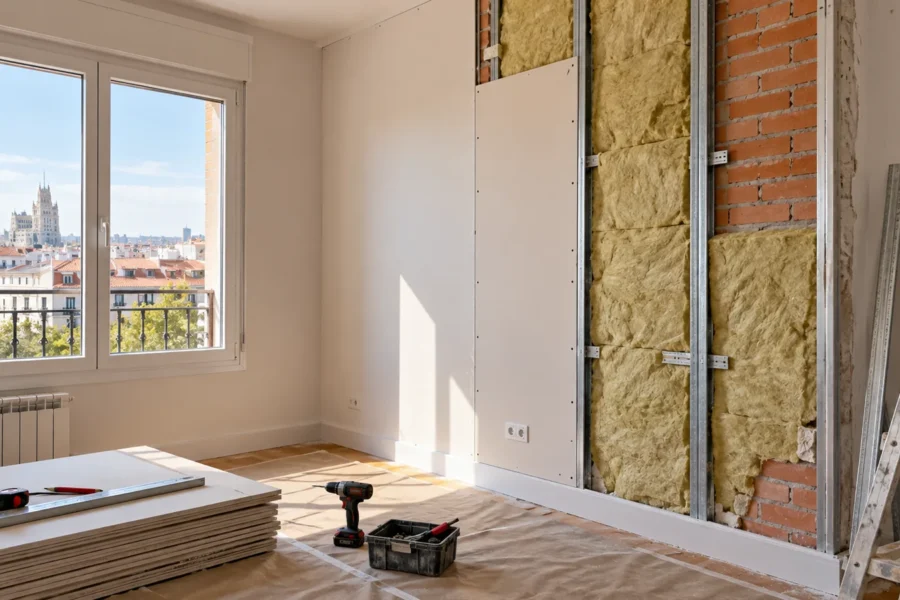
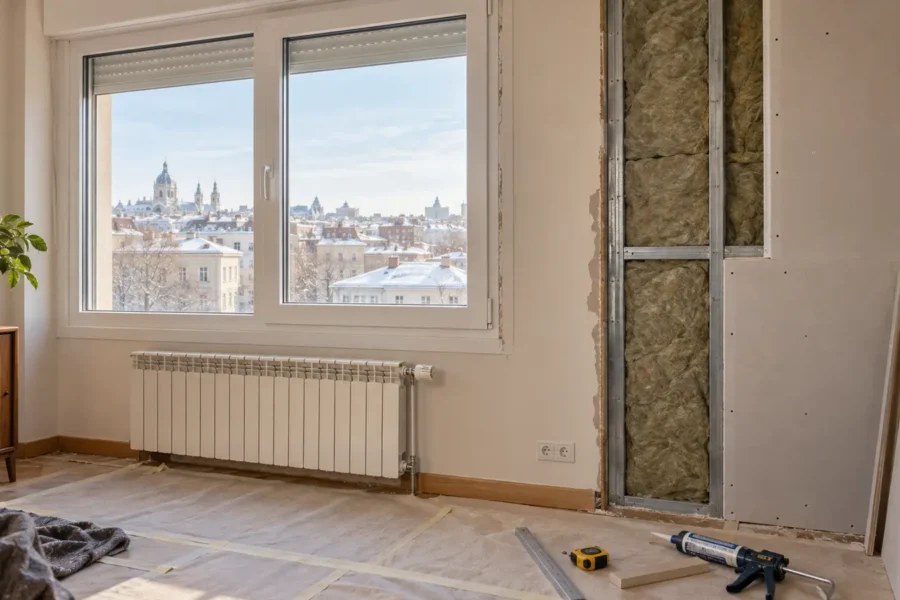
Insulation from the inside can be an option where external work is not practical, but it requires careful detailing at columns, floor slabs, partitions and windows.
It also reduces some internal floor area.
More importantly, simply lining a cold wall is not always sufficient. An incorrectly designed internal insulation system can move the coldest point elsewhere or create moisture risks within the construction.
Window replacement and correct installation
Higher-performance windows can improve comfort and reduce heat transfer, but the frame itself is only part of the detail.
The junction between the window and the wall must also be properly resolved. Otherwise, air leakage or a thermal discontinuity can remain around the perimeter even after the window has been replaced.
Replacing old windows with more airtight units can also change the ventilation behaviour of a property. Ventilation and indoor humidity should therefore be considered as part of the same assessment.
Improving roller-shutter boxes
Roller shutters are extremely common in Madrid flats and houses. Older shutter boxes may contain limited insulation or allow unwanted air leakage.
Depending on the construction, improving insulation and airtightness around the box can be a relatively localised intervention, provided that the shutter mechanism continues to operate correctly.
Treating construction junctions
Columns, floor edges, roof junctions, balconies and window openings require construction-specific details.
This becomes particularly important during a renovation because these areas are easier to assess before new drylining, suspended ceilings, flooring or decorative finishes conceal the existing construction.
Ventilation and humidity control
Ventilation does not remove a thermal bridge. However, controlling indoor moisture can reduce the likelihood of condensation forming on colder surfaces.
The objective should be to consider insulation, airtightness, ventilation and heating or cooling together rather than treating each system independently.
When may a more comprehensive renovation be appropriate?
If a property has multiple cold areas, ageing windows, discontinuous insulation, roof defects and generally poor envelope performance, correcting each symptom individually may not provide the most coherent solution.
In that situation, it can be more useful to assess the building envelope as a system: external walls, roof, windows, ventilation and climate control.
Where these measures coincide with substantial changes to layout, services and finishes, they can be coordinated as part of a full renovation in Madrid.
This allows technical issues to be considered before walls, ceilings, joinery and final finishes are completed.
Thermal bridges in different types of Madrid property
Flats in apartment buildings
Particular attention should be paid to structural columns within façades, floor slab edges, roller-shutter boxes, window perimeters and external corners.
Top-floor flats, ground-floor properties and corner apartments may also have different exposure from flats surrounded by other heated dwellings.
Penthouses
Penthouses can require additional attention at the junction between external walls, roof areas, terraces and parapets.
A mark near the ceiling should not automatically be classified as a thermal bridge: roof leakage, terrace waterproofing and drainage should also be investigated.
Detached and semi-detached houses
In houses, potential thermal weaknesses may also occur at roof junctions, floors above garages or other unheated spaces, terraces, porches and structural elements extending outdoors.
Older Madrid buildings
Madrid has a wide range of building ages and construction systems. Older properties may have external walls and structural details that differ substantially from current construction standards.
This does not mean that every older building has serious thermal problems. It does mean that the existing construction should be understood before selecting insulation or replacement systems.
Partially renovated properties
A partial rehabilitation may improve one section of the building while leaving another unchanged.
The junction between the new and existing systems should be reviewed carefully because the weakest thermal point can sometimes move rather than disappear.
What should buyers and investors check before purchasing?
Thermal bridges should not only be considered once visible mould has appeared. For buyers and property investors, they can form part of the technical review carried out before acquisition or refurbishment.
- Inspect external corners, columns and window surrounds.
- Look for blistered paint, staining or recently repainted isolated areas.
- Ask whether mould or condensation appears during winter.
- Review the age and condition of the windows.
- Check whether the façade or roof has previously been rehabilitated and what work was actually included.
- Pay particular attention to roof junctions in penthouses.
- In houses, review roofs, terraces and floors above garages or other unheated areas.
- If a substantial renovation is planned, assess the envelope before specifying drylining, windows or HVAC systems.
- If there are significant doubts, consider a technical inspection or thermal-imaging survey under appropriate conditions.
An certificado de eficiencia energética — Spain’s Energy Performance Certificate — provides useful information about the overall energy performance of a property, but it should not be treated as a detailed diagnosis of every individual thermal bridge.
What should be checked before renovating?
A major renovation is an opportunity to investigate parts of the building that may later be concealed behind new finishes.
Before closing walls or installing new finishes, it may be sensible to review:
- continuity of insulation;
- wall-to-structure junctions;
- window perimeters;
- roller-shutter boxes;
- roof and terrace junctions;
- possible air leakage;
- ventilation conditions;
- previous damp problems;
- compatibility between proposed construction systems.
Quick thermal-bridge checklist
- Are any corners, columns or window surrounds noticeably colder than nearby surfaces?
- Does condensation repeatedly appear in the same place?
- Does mould return after cleaning or repainting?
- Do roller-shutter boxes feel particularly cold or draughty?
- Have windows been replaced without reviewing insulation and ventilation?
- Could a leak or water-ingress problem be mistaken for condensation?
- Are renovated parts of the property connected to areas with little or no insulation?
- Have surface temperature and indoor humidity been measured?
- Does the proposed repair address the underlying construction detail rather than just the visible finish?
Frequently asked questions about thermal bridges
Does a thermal bridge always cause mould?
No. A thermal bridge can exist without mould. The risk increases when an internal surface becomes sufficiently cold and indoor humidity remains high enough for a prolonged period.
Will replacing the windows eliminate thermal bridges?
Not necessarily. Window performance, installation, the surrounding wall detail, roller-shutter box and ventilation all need to be considered.
Does a black mark in a corner prove there is a thermal bridge?
No. It may be one possible explanation, but indoor humidity, ventilation, plumbing leaks and external water ingress should also be considered.
Can thermal imaging confirm a thermal bridge?
Thermal imaging can reveal useful temperature patterns, but it must be carried out under appropriate conditions and interpreted alongside the construction and other evidence.
Can a thermal bridge be corrected from inside the property?
In some cases, yes. Internal insulation or localised construction details may be appropriate, but the solution must be designed around the existing wall and its junctions rather than applied as a generic lining.
Should thermal bridges be checked before a full renovation?
Yes. A renovation provides an opportunity to assess insulation, window junctions and hidden construction details before new walls, ceilings and finishes make them more difficult to access.
Diagnose the cause before deciding on the intervention
Thermal bridges can influence comfort, energy performance and the risk of condensation, but their symptoms can overlap with water ingress, air leakage, poor ventilation and other building defects.
Before insulating a wall, replacing a window or repainting a mould-affected area, the priority should therefore be to establish what is actually happening and how the relevant part of the building has been constructed.
At Maceta y Cortafrío, we can carry out an initial assessment of homes, investment properties, commercial premises and offices in Madrid to help determine what should be investigated before renovation work is planned. Where specialist calculations, surveys or technical documentation are required, the intervention should be coordinated with the appropriate qualified professional.
If you are buying, renovating or rehabilitating a property in Madrid and have noticed cold walls, condensation, mould or unexplained comfort problems, you can contact us to discuss an initial assessment before deciding on the work.
Technical sources
- Spanish Technical Building Code — DB HE Energy Saving.
- DA DB-HE/3 — Thermal Bridges.
- CTE DB-HE Application Guide.
This article is intended for general information. The diagnosis and correction of thermal bridges depend on the construction system, the condition of the property and its actual use. Planning procedures, homeowners’ association requirements, technical regulations and any grants or incentives that may apply should be checked for the specific project before work begins.