Updated 12 September 2026
New European rules will accelerate energy-efficiency improvements to buildings in Spain over the coming years. However, 2030 is not a blanket deadline requiring every homeowner to renovate their property. The principal obligation falls on Spain as a Member State: it must reduce the average energy consumption of its residential building stock and direct a substantial part of that improvement towards the least efficient buildings.
If you own a flat or house in the Madrid Region, it is important to distinguish between measures that have already been approved, decisions that Spain must still define and sensible steps you can take without rushing into unnecessary work.
The short answer: will every home have to be renovated by 2030?
No. The Energy Performance of Buildings Directive (EU) 2024/1275 does not require every existing home in Spain to be renovated by, or from, 2030.
For residential buildings, the Directive requires each Member State to reduce the average primary energy use of its entire housing stock. Spain must introduce policies capable of meeting that trajectory, but the EU text does not automatically assign building work or an individual deadline to every property owner.
- By 2030: the average primary energy use of the residential building stock must fall by at least 16% compared with 2020.
- By 2035: the reduction must reach between 20% and 22% compared with 2020.
- By 2050: the overall objective is a zero-emission building stock.
In other words, 2030 is a national energy-policy milestone. It is not an EU order requiring every private home to achieve a particular energy rating by that year.
Why will the least efficient buildings be prioritised?
The Directive states that at least 55% of the required reduction in average residential energy use must be achieved through the renovation of the 43% worst-performing residential buildings.
This is intended to prevent improvement programmes from focusing only on homes that already perform reasonably well. It directs more investment towards properties with greater energy losses. It does not mean that every building within that 43% must be renovated by 2030.
Future Spanish measures may therefore prioritise buildings with inadequate insulation, older windows, inefficient heating and cooling systems or particularly high energy demand. The method used to identify properties, together with any exemptions, incentives or individual requirements, must be defined through Spanish legislation and implementation programmes.
Homes and non-residential buildings: an important distinction
Some of the confusion surrounding the 2030 rules comes from applying requirements for offices, shops and other non-residential buildings to existing homes. The Directive treats these groups differently.
| Building type | EU objective | How it applies |
|---|---|---|
| Residential | Reduce average primary energy use by at least 16% by 2030 and 20–22% by 2035 | A national building-stock trajectory; Spain chooses the detailed measures |
| Non-residential | Address the 16% worst-performing stock by 2030 and the 26% worst-performing stock by 2033 | Minimum energy-performance thresholds for buildings in this group |
| New buildings | Zero-emission standard from 2030; from 2028 for new public buildings | A new-build requirement, not a standard imposed on every existing home in 2030 |
The timetable for non-residential buildings or new construction should not be presented as though it applied automatically to an existing flat or house.
Will a low energy rating make renovation compulsory?
Spain’s Certificado de Eficiencia Energética, normally shortened to CEE, is the official energy performance certificate for a property. It assigns a rating and contains recommendations for improvement. It provides useful information about the starting point, but it does not in itself constitute an order to carry out building work.
Under Spain’s Royal Decree 390/2021, the energy rating must already be shown when qualifying properties are advertised for sale or rent, and the relevant documentation must be provided to the buyer or tenant. At present, there is no general national minimum residential rating that prevents a home from being sold or let in 2030.
The European Directive will strengthen and standardise energy performance certificates. However, any future restriction affecting a particular transaction would have to be established expressly in Spanish law. A rating of E, F or G does not currently mean that a home will automatically be barred from sale or rental in 2030.
What is Spain preparing?
Spain submitted a draft Plan Nacional de Renovación de Edificios — the National Building Renovation Plan — to the European Commission in December 2025. According to the Spanish Government’s official announcement, the draft proposes reducing residential energy consumption by 25% by 2030 and 33% by 2035, exceeding the minimum EU targets.
The Government described its proposed 2030 saving as equivalent to the comprehensive renovation of 1,567,986 homes. The word equivalent matters: this figure does not represent a fixed list of 1.57 million properties that have each been ordered to undergo a full renovation.
The Directive set 29 May 2026 as its general transposition deadline. Spain’s final renovation plan was expected by 31 December 2026. At the date of this guide, further Spanish rules and the final plan remained essential to determining:
- which homes or buildings will be prioritised;
- whether particular circumstances will trigger specific requirements;
- which exemptions will apply;
- what grants, finance or tax incentives will be available;
- how vulnerable households will be protected;
- which authority will manage each measure and according to what timetable.
A grant should never be treated as guaranteed before the relevant official scheme has been checked and an award has been confirmed. Eligibility can depend on the municipality, the applicant, the building, the proposed work and the available budget.
If your property is within Madrid city, you can also consult our English-language guide to the Plan Rehabilita Madrid 2026 grants. This is a municipal scheme and does not cover properties elsewhere in the Madrid Region.
What can a Madrid property owner do now?
There is no reason to start building work simply because of a supposed blanket 2030 deadline. There may nevertheless be good reasons to assess your property now, particularly if you are already considering a full renovation, sale, rental project or improvement to thermal comfort.
- Check the energy performance certificate. Confirm whether it is current and registered where required. A G-rated certificate is valid for a maximum of five years; certificates in the other categories may remain valid for up to ten years.
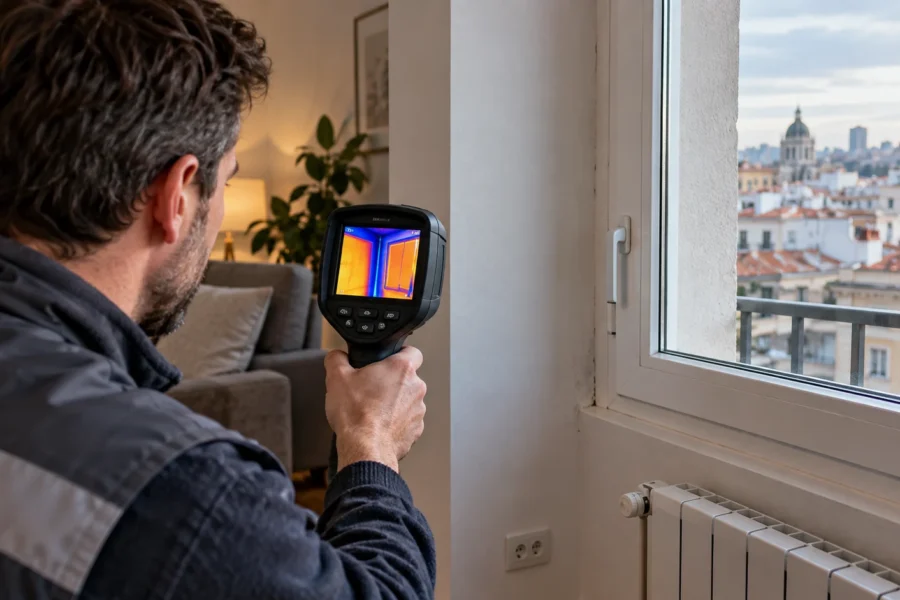
- Request a technical assessment. The letter rating alone does not identify every source of energy loss or determine which intervention offers the best balance between cost, savings and comfort.
- Assess the home as a complete system. Windows, external walls, roofs, floors, thermal bridges, air leakage, ventilation and heating or cooling systems all interact. Replacing one element without assessing the others can limit the result.
- Use a planned renovation as an opportunity. If finishes or layouts are already being renewed, integrating insulation, more efficient systems or airtightness improvements can help avoid duplicated work later.
- Check the homeowners’ association requirements. In a block of flats, work affecting façades, roofs, courtyards, external windows or communal systems may require the approval of the comunidad de propietarios, the building’s homeowners’ association.
- Confirm planning requirements and grants before appointing a contractor. The appropriate licence, responsible declaration or other planning authorisation depends on the municipality, the scope of work and whether the building is protected.
Which improvements are normally assessed in an energy renovation?
The right solution depends on the building, its orientation, condition, existing systems and available budget. Measures commonly considered include:
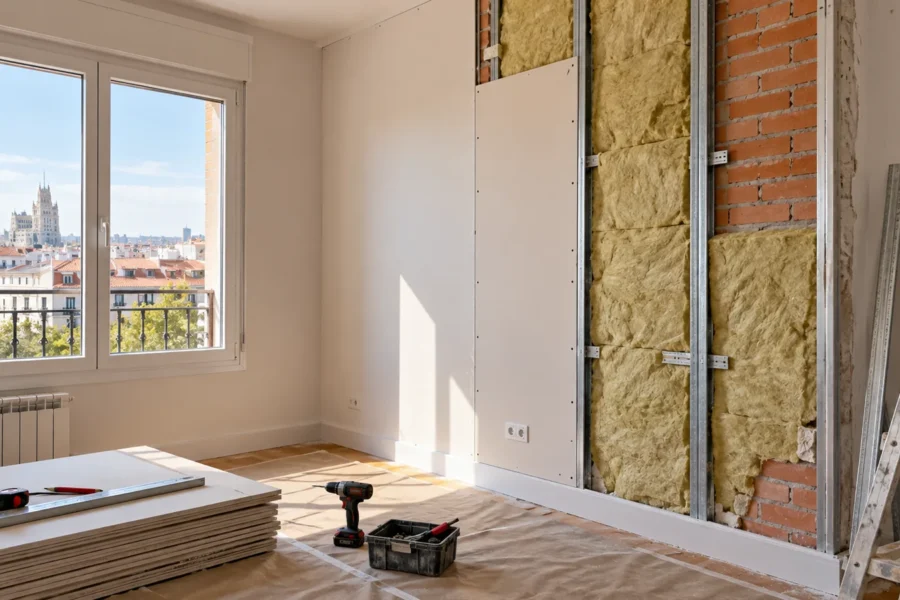
- thermal insulation to external walls, internal linings, roofs or floors;
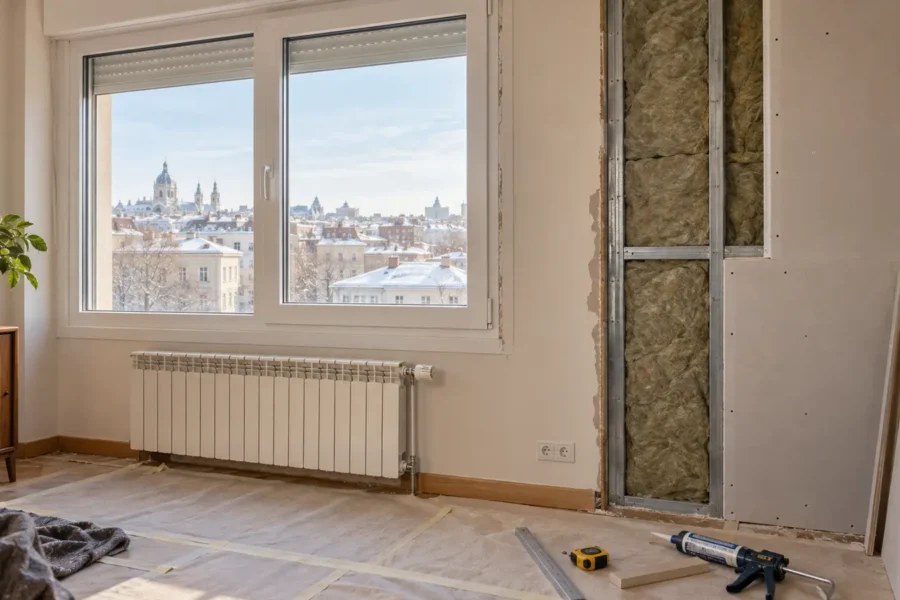
- replacement windows and improvements to shutter boxes, seals and surrounding junctions;
- reducing uncontrolled air leakage while maintaining suitable ventilation;
- external shading or solar-control measures to limit summer overheating;
- more efficient heating, cooling and domestic hot-water systems;
- renewable energy systems where technically and financially appropriate;
- controls, zoning and energy-consumption monitoring.
In the Madrid Region, it is particularly important to consider both winter heat loss and summer overheating. A suitable design should improve thermal comfort while maintaining ventilation and reducing the risk of condensation.
Common mistakes to avoid
- Renovating only to chase a higher letter rating. Energy use, comfort, indoor environmental quality, maintenance and the way the home is occupied all matter.
- Replacing windows without reviewing ventilation and installation details. A more airtight home requires an appropriate ventilation strategy.
- Building an unconfirmed grant into the budget. The project should remain financially viable if funding is delayed or not awarded.
- Applying a generic solution. Two properties with the same energy rating may require very different interventions.
- Starting work without technical coordination. Some measures require a technical project, a qualified professional, homeowners’ association approval or municipal authorisation.
Frequently asked questions
Will I have to renovate my home by 2030?
There is no blanket EU requirement compelling every homeowner to renovate by 2030. Spain must meet national building-stock targets and still has to define parts of the practical implementation.
Will I be able to sell or rent a home rated E, F or G?
Current Spanish rules require an energy performance certificate and disclosure of the rating in the relevant circumstances. They do not establish a general national minimum residential rating that prevents sale or rental in 2030.
Does the energy certificate tell me exactly which work to carry out?
The certificate includes recommendations, but it does not replace a property-specific technical assessment or automatically require every suggested measure to be implemented.
Should I wait until every rule has been finalised?
That depends on the condition of the property and your plans. If a renovation is already necessary, assessing energy improvements now may prevent completed areas from having to be reopened later. The proposed solution should be technically coherent, and the applicable regulations and grants should be checked before contracts are signed.
Plan ahead without unnecessary alarm
Energy renovation will become increasingly important, but the right response is not to renovate out of fear of 2030. A better approach is to understand the present condition of the home, prioritise the measures with the greatest practical impact and coordinate energy performance with comfort, budget and maintenance.
At Maceta y Cortafrío, we can assess how insulation, windows and building services may be integrated into a full renovation in the Madrid Region. Where the scope requires certification, specialist calculations or a technical project, the appropriate qualified professionals should be involved.
Request an assessment for your renovation project and tell us about the property, its location and the improvements you are considering.