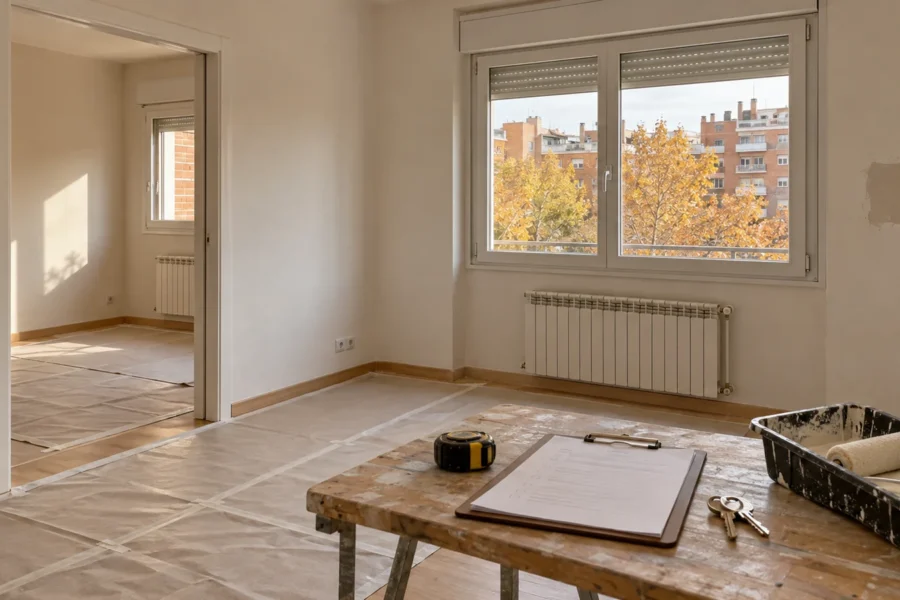
If you want to renovate your home before Christmas in Madrid, timing is crucial. A cosmetic update may take 2–4 weeks, a standard renovation normally requires 6–10 weeks, and a full renovation can take 12–20 weeks or longer. These periods exclude part of the design, permit and procurement stage, so planning should begin well before work starts.
Completing a renovation before Christmas is possible, but only when the scope, materials, permissions and construction sequence are defined realistically. Starting demolition without resolving these matters rarely saves time. It usually transfers unresolved decisions to the most expensive and disruptive stage of the project.
This guide explains the main scenarios, typical deadlines and risks involved in renovating a flat or house in Madrid before the festive season. If you are still defining the project, our guide to planning a full renovation in Madrid provides a useful starting point.
The reality of renovating before Christmas: timelines and completion dates
The first question is not simply whether the renovation can be finished by Christmas. It is whether the desired scope can be completed properly, tested and handed over with enough time to resolve minor defects before the home is needed.
| Renovation scenario | Typical on-site duration | Sensible preparation period | Recommended latest start |
|---|---|---|---|
| Cosmetic update | 2–4 weeks | 1–3 weeks | Late November, depending on scope |
| Partial renovation | 4–8 weeks | 2–5 weeks | October or early November |
| Standard full renovation | 8–14 weeks | 4–8 weeks | September or early October |
| Complex full renovation | 12–20 weeks or more | 6–12 weeks | Summer or early September |
These are indicative periods. The actual programme depends on the size and condition of the property, the availability of materials and trades, municipal requirements and whether the design changes during construction.
A project is not genuinely complete when the main trades leave. It should also allow time for testing installations, fitting accessories, adjusting doors, cleaning the property and correcting outstanding items. Ideally, practical completion should be planned at least one or two weeks before the date on which the home must be fully operational.
What counts as a full renovation?
A full renovation normally affects several parts of the home and requires different trades to work in a coordinated sequence. It may include:
- Demolition and removal of existing finishes.
- Changes to the layout or internal partitions.
- Replacement of plumbing, drainage and electrical installations.
- Kitchen and bathroom renovation.
- New flooring, wall finishes and ceilings.
- Windows, internal doors and bespoke joinery.
- Heating, ventilation or air-conditioning work.
- Painting, final fittings and decoration.
Each activity depends on previous work being completed and checked. A delay to the electrical plan, a drainage route or a made-to-measure kitchen can therefore affect several subsequent trades.
If this is the type of project you are considering, you can review our full renovation service in Madrid.
Checklist: can your renovation be completed before Christmas?
Before agreeing to a completion date, check whether the following points have been resolved:
- The scope and layout have been approved.
- Accurate measurements and drawings are available.
- A detailed quotation and written contract have been accepted.
- The necessary municipal procedure has been identified.
- The owners’ association has been informed where required.
- Working hours and use of communal areas have been agreed.
- Materials have been selected and their availability confirmed.
- Bespoke products have confirmed manufacturing dates.
- The waste-removal and loading arrangements have been planned.
- A realistic construction programme identifies critical tasks.
- A contingency allowance has been included in the budget.
- A fallback plan exists in case part of the project is delayed.
If several of these items remain unresolved, the proposed start date is not yet a reliable construction date. It is only an intention.
When you start completely changes the level of risk
Demand for renovation work in Madrid often increases from September to November. Clients want to finish before Christmas, while suppliers, installers and specialist workshops receive a concentrated volume of orders.
| Project status | Typical risk level | Practical approach |
|---|---|---|
| Design and procurement completed by summer | Low to moderate | Suitable for many full renovations, subject to permits and complexity. |
| Project defined in September | Moderate | Prioritise stock materials and confirm specialist availability immediately. |
| Full renovation starting in October | High | Only realistic with a controlled scope, available materials and a strong programme. |
| Project first discussed in November | Very high | Consider a partial renovation or a temporary Christmas-ready solution. |
| Work beginning in December | Critical | Limit the work to short, non-structural and low-dependency tasks. |
August can also influence the programme. Some factories, workshops and suppliers reduce activity during this period. If work is intended to begin in September, orders for bespoke items may need to be placed before the summer slowdown.
How long does each part of a renovation take?
The following periods are broad estimates for a residential project. Some tasks overlap, while others must be completed sequentially.
| Phase | Typical duration | Main dependencies |
|---|---|---|
| Survey, design and quotation | 2–6 weeks | Property access, decisions and technical information |
| Municipal procedure | From immediate effect to several weeks or months | Type of work, documentation and protected status |
| Procurement | 1–8 weeks or more | Stock, bespoke manufacture and delivery schedules |
| Site protection and demolition | 3–10 working days | Access, waste removal and existing construction |
| Partitions and preliminary building work | 1–3 weeks | Approved layout and discovered defects |
| Plumbing and electrical first fix | 1–3 weeks | Final positions of sanitaryware, lighting and appliances |
| Plastering, levelling and drying | 1–3 weeks | Humidity, thickness and ventilation |
| Bathroom and kitchen finishes | 2–5 weeks | Waterproofing, tiles, units, worktops and appliances |
| Flooring, joinery and painting | 2–5 weeks | Dry substrates and protected finished surfaces |
| Testing, snagging and cleaning | 3–10 working days | Utilities connected and all trades available |
Kitchens and bathrooms
Kitchens and bathrooms usually sit on the project’s critical path because they combine building work, plumbing, electricity, waterproofing, tiling, furniture and specialist products.
A made-to-measure worktop normally cannot be manufactured until the base units have been fitted and measured. Likewise, a bespoke shower screen is usually measured after the wall and floor finishes are complete. These dependencies must be reflected in the programme.
For more detail, see our guides to bathroom renovation timelines in Madrid and our services for kitchen renovations and bathroom renovations in Madrid.
Drying and curing periods
Drying times are part of the work, not inactive days that can always be removed from the schedule. Waterproofing, screeds, adhesives, plaster, grout, paint and sealants all require suitable conditions before the next activity begins.
Closing a wet surface too early can lead to loose finishes, staining, trapped moisture or failed seals. Accelerating the project should come from better preparation and coordination, not from ignoring manufacturers’ instructions.
Permits, documentation and inspections in Madrid
The municipal procedure depends on the location, building and exact nature of the work. In Madrid, internal renovation work that does not affect the structure, protected elements, communal installations or use of the property may follow a simplified route, such as a prior communication or responsible declaration.
Some basic maintenance work—such as painting or replacing certain finishes in a non-protected property—may not require the same municipal procedure. Structural alterations, changes of use, façade work or intervention in protected buildings can require more extensive documentation and authorisation.
A responsible declaration may take effect once it has been correctly submitted and entered in the register, but it remains subject to subsequent municipal checks. “Immediate effect” therefore does not mean that incomplete documentation or non-compliant work is acceptable.
Before work begins, verify:
- The planning status and possible protection of the building.
- Whether the project affects structural or communal elements.
- The applicable municipal procedure.
- Whether technical drawings or professional certification are required.
- Waste-management and public-space requirements.
- Any notification or approval required by the owners’ association.
Skips, waste bags and loading arrangements
Urban logistics can influence the schedule, particularly in central Madrid, narrow streets or controlled parking areas. Waste collection, material deliveries and temporary occupation of public space should be arranged before demolition.
As an indication, placing a skip or waste bag in an authorised parking area may require communication at least two working days in advance. Occupation of a pavement or another special area may require an application at least ten working days beforehand and remains subject to authorisation and local conditions.
If the property has no lift, materials and waste may need to be carried manually. This can extend demolition, deliveries and final cleaning, particularly in older buildings.
The owners’ association
Even where municipal permission is straightforward, the community rules must be respected. Confirm:
- Permitted working and noisy-work hours.
- Protection required inside the lift and entrance hall.
- Whether the lift can be used for materials and rubble.
- Where deliveries can wait or be unloaded.
- Who is responsible for cleaning communal areas.
- Whether access keys or concierge coordination are needed.
Madrid’s general noise rules restrict construction activity during certain night-time periods, but an owners’ association may establish stricter practical rules. Advance communication helps prevent complaints and interruptions.
Budget and contingency for a renovation in Madrid
A rushed project should not rely on a budget with no margin. Older Madrid properties can conceal corroded pipes, obsolete wiring, uneven floors, damp patches or weakened partitions. These issues may only become visible after demolition.
A contingency of approximately 10–15% is often sensible for an older property, although the appropriate figure depends on the survey, project size and degree of uncertainty.
The quotation should clearly define:
- What work and materials are included.
- What is excluded.
- Provisional sums or estimated items.
- Payment milestones linked to progress.
- How variations will be approved and priced.
- Who manages permits and waste.
- The planned start and estimated completion dates.
It is also advisable to request evidence of the contractor’s civil liability insurance and suitable documentation for specialist electrical, plumbing, gas or heating installations.
How to accelerate a renovation without turning it into a race
The safest way to shorten a programme is to remove uncertainty before work starts.
Complete the design before demolition
Finalise the layout, electrical points, lighting, sanitaryware, kitchen configuration, doors and principal finishes. Decisions made during construction can stop several trades at once.
Choose available materials
Stocked tiles, flooring, sanitaryware and standard-sized units are generally safer when the completion date is fixed. A special finish is only useful if its delivery date is compatible with the programme.
Our guide to choosing renovation materials in Madrid explains how to balance appearance, maintenance, availability and budget.
Separate essential work from optional improvements
Create three lists:
- Essential: work required for safety, function and habitability.
- Important: work that should be included if the programme allows.
- Optional: decorative or bespoke additions that can be installed later.
This distinction allows a project to respond to a delay without compromising essential installations or finishes.
Use a coordinated team
Independent trades can work successfully, but someone must control the sequence, measurements, deliveries and interfaces between them. A clear site manager and a shared programme reduce lost days between activities.
Approve decisions promptly
Set an agreed response time for quotations, samples and unexpected findings. A project can lose several days while waiting for approval of a relatively small change.
Plan B: preparing your home for Christmas in 2–4 weeks
If there is no longer enough time for a full renovation, a controlled partial intervention may improve the home substantially without creating an unfinished building site over Christmas.
| Possible intervention | Indicative duration | Main limitation |
|---|---|---|
| Painting and minor wall repairs | 3–7 days | Walls must be reasonably dry and stable |
| Lighting, switches and visible electrical updates | 1–4 days | No major rewiring or concealed routes |
| Replacement taps, furniture and accessories | 1–5 days | Existing connections remain in place |
| Kitchen fronts, handles and selected appliances | 1–3 weeks | Compatible measurements and available products |
| Bathroom cosmetic update | 1–3 weeks | No substantial layout or drainage changes |
| Selected flooring without major levelling | 3–10 days | Suitable existing substrate and clear rooms |
Another option is to complete one self-contained area and postpone the rest. For example, a guest bathroom, entrance hall or living room may be finished and cleaned while the full renovation is rescheduled for a less pressured period.
For a smaller-scope project, our example of what can be renovated in Madrid with a €5,000 budget offers additional ideas.
Communication and risk management
A reliable programme should identify both progress and risk. Weekly communication can include:
- Work completed during the week.
- Work scheduled for the following week.
- Materials received and pending.
- Decisions required from the homeowner.
- Unexpected findings and their impact.
- Current completion forecast.
- Items moved to a later phase.
Payment milestones should correspond to identifiable progress, not simply calendar dates. Any change to cost or duration should be documented before the additional work proceeds whenever possible.
What should happen two weeks before Christmas?
Two weeks before the home is needed, the project should no longer depend on demolition, major wet work or uncertain deliveries. Attention should have moved to testing, adjustments, snagging and cleaning.
A sensible pre-handover checklist includes:
- Water, electricity, heating and ventilation are operational.
- Leaks and drainage have been tested.
- Sanitaryware, appliances and essential lighting are usable.
- Doors, windows and locks operate correctly.
- Wet finishes have cured sufficiently.
- Outstanding work is recorded in writing.
- Rubble, tools and protective materials are being removed.
- A professional final clean has been scheduled.
- Instructions, warranties and certificates are being collected.
If major construction is still underway at this point, agree on a safe and realistic handover strategy. Moving into a property with exposed installations, uncontrolled dust or unusable bathrooms should not be treated as normal completion.
Frequently asked questions about renovating before Christmas
When should a full renovation begin to finish before Christmas?
For a standard full renovation, it is generally advisable to begin the design and procurement stage before or during summer and start site work around September. More complex projects may need to begin earlier. Starting in October significantly increases the risk unless the scope and supply chain are already controlled.
Can a flat be fully renovated in eight weeks?
It can be possible for a smaller, straightforward property with a completed design, available materials and no serious hidden defects. Eight weeks should not be treated as a universal promise, particularly where layouts, communal installations or bespoke joinery are involved.
Can I live in the property during the work?
Living in the property may be possible during limited or phased work. It is much harder during a full renovation involving demolition, dust, noise and interruptions to water or electricity. If the only bathroom or kitchen is unusable, temporary accommodation is usually more practical.
What items most commonly delay completion?
Bespoke kitchens, stone worktops, shower screens, internal doors, specialist tiles and made-to-measure joinery are frequent risks. Hidden damp, outdated wiring, communal drainage issues and last-minute design changes can also extend the programme.
Do internal renovation works always require a permit in Madrid?
No. The applicable procedure depends on the type of work, building and level of protection. Some maintenance tasks may be exempt, while other works require a responsible declaration or licence. The requirements should be verified for the specific property before starting.
What happens if hidden defects appear?
The affected area should be assessed before it is covered. The contractor should explain the proposed solution, additional cost and effect on the programme. Keeping a contingency allowance and an agreed variation procedure helps avoid rushed decisions.
Is it better to postpone part of the renovation?
Yes, when an optional element threatens the safe completion of essential work. Bespoke furniture, decorative fittings or the renovation of a secondary room can often be completed in a later phase without compromising the main project.
So, will your home be ready for Christmas?
The answer depends less on optimism than on preparation. A project has a reasonable chance of meeting the deadline when:
- The design and scope are closed.
- The municipal and community requirements are known.
- Critical materials have confirmed delivery dates.
- The programme includes dependencies and curing periods.
- The contractor has the required trades available.
- The budget includes a realistic contingency.
- Completion is planned before, rather than immediately before, Christmas.
If these conditions are not in place, reducing the scope or postponing part of the project is usually preferable to spending the festive period in an unsafe or unfinished home.
Planning a renovation in Madrid before Christmas?
Maceta y Cortafrío plans and carries out residential renovations across Madrid, coordinating the technical work, materials, trades and practical site logistics.
We can review your property, priorities and intended completion date to determine which scope is realistic. Contact Maceta y Cortafrío to request an initial assessment of your renovation.
The timelines and procedures in this guide are indicative. They may vary according to the property, project scope, current regulations of Madrid City Council and the rules of the owners’ association. Always confirm the applicable requirements before work begins.
Sources and official information
- Madrid City Council electronic office: municipal procedures, responsible declarations and licences.
- Madrid City Council: public-space occupation, waste containers and local regulations.