How to Improve Your Home’s Energy Rating in Madrid: Upgrades, Costs and Real Savings
Improving an Energy Performance Certificate by one band is not a matter of buying one particular product. The outcome depends on the property as a whole: insulation, windows, orientation, exposed surfaces, building services, fuel and system efficiency. A measure that works well in a detached house may have little effect in a mid-floor flat.
This guide explains the measures commonly considered in the Community of Madrid, their approximate cost and how they may affect calculated energy use and household bills. The figures are indicative gross market ranges reviewed in September 2026, not quotations. Unless stated otherwise, they assume supply, installation and indicative VAT, but exclude professional design, planning or administrative charges, exceptional scaffolding, asbestos removal, repairs to existing defects and grants.
Important: the percentages are technical ranges for properties where the measure corrects a genuine weakness. They must not simply be added together. Any change of rating must be checked by modelling the existing property and the proposed measures with an officially recognised calculation method, under the responsibility of a competent professional in Spain.
How Spain’s energy rating works
Spain’s Certificado de Eficiencia Energética (Energy Performance Certificate, or EPC) describes the thermal envelope and building services and calculates performance under standardised occupancy and operating conditions. Ratings run from A, the most efficient, to G, the least efficient. The label gives two principal ratings: non-renewable primary energy consumption and carbon dioxide emissions, usually stated per square metre per year.
- Energy demand: the heat or cooling the building needs to maintain reference indoor conditions. Insulation, windows, solar protection, airtightness and thermal-bridge treatment primarily affect this figure.
- Final energy consumption: the electricity, mains gas, heating oil or other energy delivered to the property and recorded in bills or fuel purchases.
- Non-renewable primary energy: a calculated indicator that also accounts for non-renewable energy used before the energy reaches the building. It is not the same as the kWh shown on a bill.
- Emissions: calculated CO2 associated with energy use, using the official conversion factors applicable to each energy carrier.
- Actual expenditure: also depends on tariffs, taxes, contracted electricity capacity, the weather in a particular year, occupancy, schedules and chosen indoor temperatures.
Two identical homes can therefore have the same certificate and very different bills. A measure may reduce a bill substantially without crossing the threshold into the next band. Conversely, a smaller percentage improvement may change the letter where the existing result is already close to a threshold.
Common energy-efficiency improvements
1. External-wall insulation
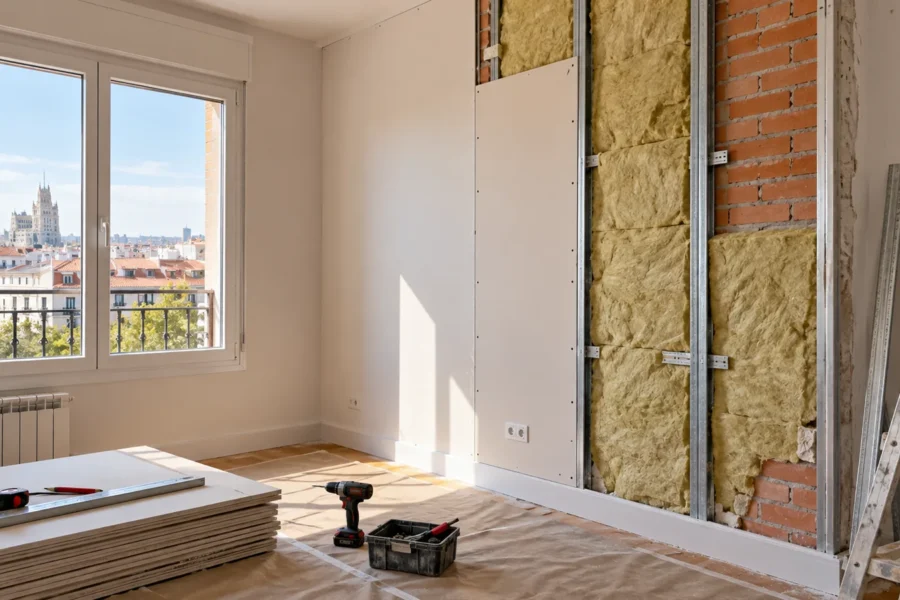
Usually suitable for: detached and semi-detached houses with poorly insulated walls, and apartment blocks undertaking a coordinated façade refurbishment. Common solutions include external thermal insulation composite systems —known in Spain as SATE— ventilated façades, cavity-wall injection where the cavity is continuous and suitable, and internal insulated linings when external work is not possible.
- Indicative cost: cavity injection, €25–€55 per m² of treated wall; internal lining, €55–€110 per m²; SATE, €110–€190 per m² of façade. Scaffolding, repairs, technical design, charges and complex junctions may increase the total.
- Potential saving: approximately 15–35% of heating and cooling demand where the walls were a major source of heat transfer.
- Possible EPC effect: medium to high for demand. It may contribute to one or more bands when combined with efficient services, but no band change can be promised.
- Simple energy payback: often 15–30 years or longer without support. It can be shorter when insulation is added to façade repairs that were already required.
- Main constraints: owners’ association approval in apartment buildings, continuity of insulation, heritage restrictions, condensation risk, loss of internal floor area and correct treatment of reveals, slab edges and roller-shutter boxes.
2. Roof and ceiling insulation
Usually suitable for: houses, top-floor flats and dwellings directly below a roof. It can offer a good cost-to-benefit ratio because the roof is highly exposed.
- Indicative cost: €45–€90 per m² when insulating an accessible loft floor or slab; €80–€160 per m² when roof layers must be lifted and rebuilt.
- Potential saving: 10–25% of thermal demand in a home with a poorly insulated roof.
- Possible EPC effect: low to medium on its own; potentially greater in a very exposed top-floor flat or house when combined with other measures.
- Simple payback: roughly 8–20 years for straightforward installations; longer where the roof is rebuilt solely for energy reasons.
- Main constraints: waterproofing, roof ventilation, junctions, available height and communal ownership in apartment blocks.
3. Floor and suspended-slab insulation
Usually suitable for: ground-floor flats above garages or open areas, and houses above unheated spaces or cold ground-bearing slabs.
- Indicative cost: €45–€90 per m² when applied to an accessible underside; €70–€140 per m² where existing flooring must be replaced from above.
- Potential saving: 5–15% of heating demand. The improvement in comfort may be more noticeable than the financial saving.
- Possible EPC effect: normally low on its own.
- Simple payback: difficult to justify on energy savings alone if the floor must be rebuilt; more reasonable as part of a wider renovation.
- Main constraints: finished ceiling or floor height, doors, stairs, ground moisture, concealed services and owners’ association approval when working from a communal garage.
4. Windows, glazing and roller-shutter boxes
Usually suitable for: homes with single glazing, frames without a thermal break, failed seals or surface condensation. Replacing only the glass will not correct a very poor frame.
- Indicative cost: €700–€1,400 per average-sized opening installed; approximately €5,000–€12,000 for a flat and €9,000–€24,000 for a house, depending on quantity, size, frame material, shutters and access equipment.
- Potential saving: 5–20% of thermal demand; potentially more where there is extensive glazing and the original windows perform very poorly.
- Possible EPC effect: low to medium. Windows may also improve comfort, noise protection and internal surface temperatures.
- Simple payback: often more than 20 years on energy savings alone. Replacement is easier to justify where windows also need renewing for condition, noise or comfort.
- Main constraints: whole-window U-value, solar factor, orientation, shading, air permeability, required background ventilation, façade appearance and owners’ association approval.
5. Air leakage and thermal bridges
Usually suitable for: homes with draughts around joints, doors, shutter boxes or service penetrations. A thermal bridge is an area where insulation is interrupted and heat passes more readily.
- Indicative cost: €300–€1,500 for targeted draught sealing; €1,500–€5,000 where shutter boxes, junctions or several thermal bridges require work.
- Potential saving: 3–10% of heating in homes with significant uncontrolled leakage.
- Possible EPC effect: generally low, although the cost-to-comfort benefit can be good.
- Simple payback: approximately 3–10 years where diagnosis confirms important leakage.
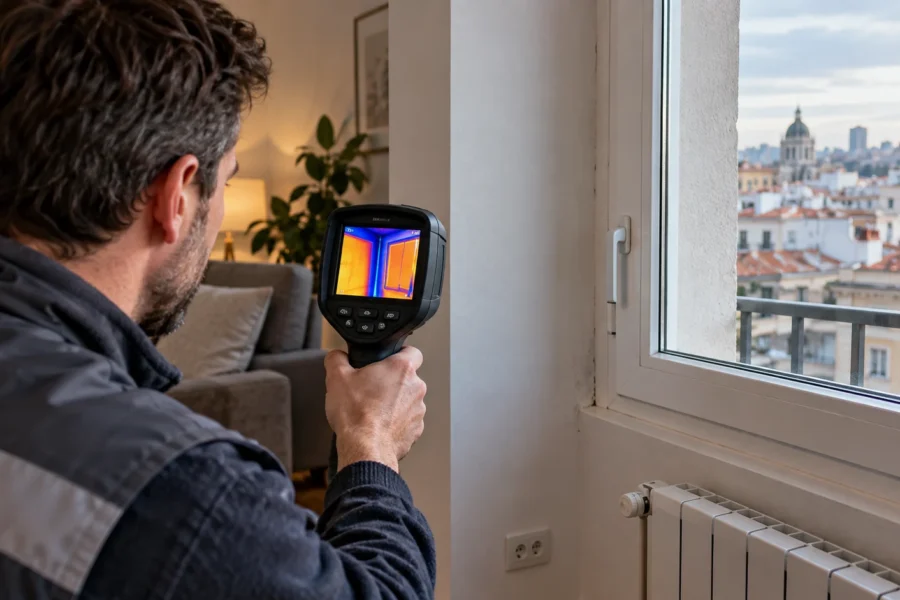
- Main constraints: a home should not be sealed without maintaining the required ventilation. A blower-door test and thermal imaging can identify defects but are not necessary in every case.
6. Replacing an old boiler or heating system
Usually suitable for: homes with an atmospheric boiler or equipment approaching the end of its service life. Replacing a working boiler should be compared with electrification, insulation and future maintenance costs.
- Indicative cost: €2,300–€4,500 for an individual condensing boiler installed. Flue work, condensate drainage, legalisation or hydraulic alterations may cost extra.
- Potential saving: 10–25% of heating and domestic hot-water fuel compared with old equipment, provided the system can condense effectively and is properly controlled.
- Possible EPC effect: low to medium. A new fossil-fuel boiler may improve the calculation but generally offers less long-term decarbonisation potential than a heat pump.
- Simple payback: approximately 6–12 years when replacing an inefficient unit, depending heavily on use and gas prices.
- Main constraints: flue discharge, condensate drainage, hydraulic balancing and return-water temperature.
7. Heat pumps and aerothermal systems
Usually suitable for: flats where efficient air-to-air units can serve the main living areas, and houses with space for an outdoor unit and heat emitters that can operate at relatively low water temperatures. An air-to-water heat pump —commonly called aerotermia in Spain— can provide heating, cooling and domestic hot water.
- Indicative cost: €1,400–€2,800 for one air-to-air split system, or €3,500–€8,000 for a multi-split arrangement; air-to-water aerothermal system, €11,000–€19,000 in a flat and €14,000–€28,000 in a house. Underfloor heating, fan coils, larger radiators, storage, electrical upgrades and ancillary building work may add €5,000–€20,000 or more.
- Potential saving: an efficient seasonal heat pump may reduce the final energy required for heating by 35–65% compared with resistance heating or an old fossil-fuel appliance. Financial savings against mains gas depend on tariffs and actual seasonal efficiency.
- Possible EPC effect: medium to high for non-renewable primary energy and emissions when properly designed. The actual system must be modelled.
- Simple payback: approximately 7–15 years when replacing heating oil or resistance electricity; potentially longer against an efficient gas boiler.
- Main constraints: heat-loss calculation, seasonal performance, flow temperature, noise, outdoor-unit position, defrost operation, contracted electrical capacity, supply capacity, space and community permissions.
Electrification does not mean using less electricity. When a boiler is removed and a heat pump provides the heating, electricity consumption normally rises because heating has moved onto the electricity bill. A heat pump can nevertheless deliver several units of heat for each unit of electricity consumed. Total delivered energy may fall, while the combined annual cost of electricity and gas may also decrease. The meaningful comparison is “electricity plus gas before” against “more electricity and little or no gas afterwards”, including standing charges.
8. Controls, thermostats and thermostatic radiator valves
Usually suitable for: almost any system with poor time or temperature control.
- Indicative cost: €150–€450 for a programmable thermostat; €70–€160 per installed valve; €900–€3,000 for more complete zoning.
- Potential saving: 5–15% of heating in homes with inadequate control.
- Possible EPC effect: low on its own, although controls can improve actual operation.
- Simple payback: frequently 2–7 years.
- Main constraints: compatibility with the boiler or heat pump, hydraulic balancing and user behaviour. A smart thermostat cannot correct a poorly insulated building.
9. Domestic hot water
Usually suitable for: homes with an old resistance-electric cylinder, long uninsulated pipe runs or high domestic hot-water use.
- Indicative cost: €150–€700 for pipe insulation and adjustments; €2,200–€4,500 for a heat-pump water heater; domestic hot-water integration may be included in a full aerothermal system or add approximately €1,500–€4,000.
- Potential saving: 40–65% of the electricity used for hot water when replacing resistance heating with a heat pump, depending on ambient temperature, usage and equipment.
- Possible EPC effect: low to medium; greater where hot water represented a large share of modelled consumption.
- Simple payback: approximately 5–12 years.
- Main constraints: space, noise, cylinder volume, air and condensate discharge, legionella prevention and distribution losses.
10. Solar photovoltaic and solar thermal systems
Usually suitable for: primarily houses with an unshaded roof. In apartment buildings, installation normally requires community approval and an agreed arrangement for shared self-consumption. Photovoltaic panels generate electricity; solar thermal panels heat water.
- Indicative cost: €5,000–€9,000 for a 3–5 kWp residential photovoltaic installation without a battery; a battery may add €4,000–€9,000. A domestic solar-thermal system may cost €4,000–€8,000 per home, with greater complexity for communal schemes.
- Potential saving: photovoltaics may reduce purchased electricity by 25–55% in a well-matched house without a battery; solar thermal may cover 40–70% of annual domestic hot-water energy. Results depend on shading, orientation, daytime use and surplus compensation.
- Possible EPC effect: medium to high for non-renewable primary energy and emissions, particularly when photovoltaics are combined with a heat pump.
- Simple payback: approximately 7–14 years for photovoltaics without a battery; highly variable and often longer for batteries or solar thermal.
- Main constraints: roof structure, waterproofing, shade, administrative registration, grid connection, community approval, maintenance and correct sizing. A battery does not automatically improve financial returns.
Quick comparison of costs and potential savings
| Measure | Cost basis | Indicative gross range in Madrid | Potential saving on the affected use | Indicative EPC effect |
|---|---|---|---|---|
| Wall insulation | m² of façade | €25–€190/m², depending on system | 15–35% of thermal demand | Medium–high |
| Roof insulation | m² | €45–€160/m² | 10–25% of demand | Low–medium |
| Floor insulation | m² | €45–€140/m² | 5–15% of heating demand | Low |
| Windows | Opening | €700–€1,400 | 5–20% of demand | Low–medium |
| Draught sealing | Property | €300–€5,000 | 3–10% of heating | Low |
| Condensing boiler | Appliance | €2,300–€4,500 | 10–25% of fuel | Low–medium |
| Air-to-air heat pump | Appliance/system | €1,400–€8,000 | 35–65% of final heating energy | Medium |
| Air-to-water heat pump | Property | €11,000–€28,000 without major emitter changes | 35–65% of final heating energy | Medium–high |
| Heating controls | Appliance/system | €150–€3,000 | 5–15% of heating | Low |
| Heat-pump hot water | Appliance | €2,200–€4,500 | 40–65% of hot-water electricity | Low–medium |
| 3–5 kWp photovoltaics | Installation | €5,000–€9,000 without battery | 25–55% of purchased electricity | Medium–high |
How to read this table: a reduction in energy demand is not the same as a reduction in bills; a saving on one affected use is not a saving on all household energy; and individual effects cannot be added linearly. If insulation is installed first, the replacement heating system may be smaller and use less energy.
Flats and houses require different decisions
For a flat
- The façade, roof, communal floor slabs and external appearance of windows often involve common elements and may require approval from the comunidad de propietarios (owners’ association).
- A mid-floor flat has less exposed surface than a top-floor or ground-floor home. New windows may substantially improve comfort without greatly changing the certificate.
- Before installing outdoor units, ductwork or solar panels, check community rules, façade and courtyard constraints, noise requirements and local regulations.
- The most accessible individual measures are often draught sealing, heating controls, efficient hot water and air-to-air heat pumps, where compatible.
For a detached or semi-detached house
- More façade, roof and floor area is exposed. Heat loss may be higher, but the owner usually has greater control over improvements.
- Improve the envelope before sizing an aerothermal system. Oversizing increases cost and can impair operation.
- The roof may make photovoltaics practical, but shading, structure and waterproofing must be assessed.
- Combining insulation, a heat pump and self-consumption normally offers greater rating potential than one measure alone.
Two illustrative financial examples
Example 1: a 90 m² flat in Madrid
Assumptions: an outward-facing, mid-floor flat built before 1980; initial E rating; 8,000 kWh/year of gas for heating and hot water; 3,000 kWh/year of electricity; simplified all-in energy prices of €0.09/kWh for gas and €0.24/kWh for electricity; unchanged occupancy, use and weather.
- Six efficient windows and improved shutter boxes: €7,500.
- Targeted draught sealing: €700.
- Thermostat and radiator valves: €800.
- Two air-to-air heat pumps serving the principal rooms: €4,200.
- Illustrative gross investment: €13,200.
Assumed outcome: gas falls to 5,200 kWh/year and electricity rises to 3,900 kWh/year. Variable energy cost before the work: €1,440/year. Cost afterwards: €1,404/year. On these assumptions, the direct saving is only €36/year, although comfort and cooling capability improve. If gas is removed entirely, its standing charge also disappears; if it remains for hot water or cooking, it does not. EPC modelling might place the flat in band D, but it could remain in E: the result depends on geometry, climate data, efficiencies and proximity to a rating threshold.
Example 2: a 180 m² detached house
Assumptions: a detached house built in the 1990s; initial F rating; 20,000 kWh/year of gas and 5,000 kWh/year of electricity; the same simplified energy prices as in the flat example.
- Partial SATE insulation and treatment of junctions: €27,000.
- Roof insulation: €9,000.
- Air-to-water aerothermal system with emitter adaptations: €18,000.
- 5 kWp photovoltaic installation without battery: €8,000.
- Illustrative gross investment: €62,000.
Assumed outcome: thermal demand falls by 38%. Heating and domestic hot water use approximately 4,500 kWh of electricity; total electricity consumption before self-consumption becomes 9,500 kWh. Photovoltaics avoid the purchase of 4,000 kWh/year, leaving net electricity purchases of 5,500 kWh. Variable energy cost before the work: €3,000/year. Cost afterwards: €1,320/year. Illustrative saving: €1,680/year. Simple gross payback is approximately 37 years, excluding finance, maintenance, replacements and energy-price changes. Where the façade or roof already requires repair, the payback on the energy-efficiency uplift alone may be shorter. A C or D rating could be plausible, but it must be verified and is not a forecast.
What the improvements really mean for energy bills
A useful financial estimate starts with at least 12 months of bills and separates energy consumption, standing charges, contracted electrical capacity and taxes. A simplified calculation is:
Annual saving ≈ avoided consumption × marginal energy price − new consumption and maintenance costs.
The EPC uses standardised assumptions; bills reflect actual behaviour. If occupants choose a higher indoor temperature after insulation because the home is more comfortable, some of the predicted saving becomes improved comfort. This is known as the rebound effect. Photovoltaic production should not simply be multiplied by the full retail electricity price either: exported surplus is normally worth less than electricity used directly in the home.
Grants and tax deductions: check before committing
The costs above are gross and do not deduct financial support. At the review date, support may come from national, Community of Madrid or municipal programmes. Not every call remains open, and some schemes exclude work started before an application is submitted.
- Spanish income-tax deductions: the temporary 20%, 40% and 60% deductions have required certified reductions in demand or consumption, pre- and post-work certificates and compliance with specific deadlines. Do not assume that work commissioned in 2026 qualifies without checking the Spanish Tax Agency (Agencia Tributaria) for the applicable payment dates, property eligibility and limits.
- Building-renovation programmes: Next Generation funds and regional schemes have linked support to minimum energy reductions, technical evidence and delivery deadlines. Check the specific Community of Madrid call before starting or paying for work.
- Municipal support: Madrid City Council and other municipalities may offer rehabilitation programmes or reductions in local property tax (IBI) or construction tax (ICIO). Availability changes by municipality and financial year.
- Energy Saving Certificates: Spain’s Certificados de Ahorro Energético (CAEs) may allow certain verified energy savings to be monetised through authorised market participants. The arrangement must be agreed and documented correctly, and the same saving cannot be counted twice under incompatible schemes.
Before relying on support in an investment appraisal, confirm that the call is open, the applicant is eligible, the proposed start date is permitted, other support is compatible, evidence is available, tax treatment is understood and the completion deadline can be met. Obtain the pre-work EPC before construction where the scheme requires it.
Priorities for three budget levels
Lower budget: up to €3,000
- Review 12 months of consumption and the existing certificate.
- Seal diagnosed air leakage without obstructing required ventilation.
- Install compatible programmable controls and thermostatic valves.
- Insulate accessible hot-water and heating pipes.
- Prioritise servicing and hydraulic balancing before replacing equipment.
Medium budget: €3,000–€15,000
- Model two or three packages rather than isolated measures.
- For flats: consider windows when they are at the end of their life, air-to-air heat pumps or efficient hot water according to consumption.
- For houses: consider straightforward roof insulation, controls and correctly sized photovoltaics.
- Reserve funds for making good, administrative registration and the post-work certificate.
Higher budget: more than €15,000
- Follow the sequence: reduce demand, size the building services and then add renewables.
- For owners’ associations: assess the façade, roof and communal systems as one coordinated project.
- For houses: compare envelope, aerothermal and photovoltaic packages on a 20-year whole-cost basis.
- Coordinate technical design, permissions, support and construction before removing the existing services.
Checks to complete before starting work
- Current EPC, available calculation files and an inspection by the certifying professional.
- Complete electricity, gas or heating-oil records covering at least 12 months.
- Assessment of damp, condensation, air leakage and thermal bridges.
- Modelling of the baseline and each improvement package with a recognised method.
- Heat-loss calculations for heat pumps; do not select an appliance by floor area alone.
- Checks on contracted electricity capacity, consumer unit, supply, noise and technical space.
- Municipal requirements, community rules and owners’ resolutions where applicable.
- An itemised quotation showing VAT, technical design, permissions, access equipment, ancillary work and waste management.
- Documented product performance: conductivity, U-values, air permeability, SCOP, output at design temperature and warranties.
- Grant or tax-relief eligibility before starting, with an acceptable payment and evidence trail.
- Photographic records of insulation layers and installations before they are concealed.
- A registered post-work EPC and comparison against the modelled scenario.
Conclusion
The most sensible strategy is not to pursue a letter in isolation. Correct the property’s significant heat losses first and then install appropriately sized systems. In a flat, many decisions depend on the building and its owners’ association. In a house, the potential is greater, but so are the investment and design requirements.
Before work begins, ask a competent professional to model several packages and compare the certificate’s standardised savings with the property’s actual bills. This allows an owner or investor to decide on cost, comfort, maintenance and emissions rather than the colour of the label alone.
Sources consulted
- Spanish Official State Gazette: Royal Decree 390/2021, consolidated text. Last update published 23 July 2025; amendments effective from 23 July 2026. Accessed 8 September 2026.
- Institute for Energy Diversification and Saving (IDAE): building energy ratings and recognised documents. Accessed 8 September 2026.
- Spanish Tax Agency: tax deductions for residential energy-efficiency work. Accessed 8 September 2026.
- Community of Madrid: housing and rehabilitation information. Accessed 8 September 2026.
- National Commission on Markets and Competition (CNMC): energy offer comparison service. Accessed 8 September 2026.
Methodological note on costs and savings: there is no single official average price for this work in Madrid. The ranges represent indicative orders of magnitude for existing homes and must be confirmed through measurement and genuinely comparable quotations. The savings are technical scenarios whose relevance depends on the initial defect and the combined package.
Related Maceta y Cortafrío services and guidance
Featured image: an AI-generated conceptual visualisation. It does not show a completed Maceta y Cortafrío project.