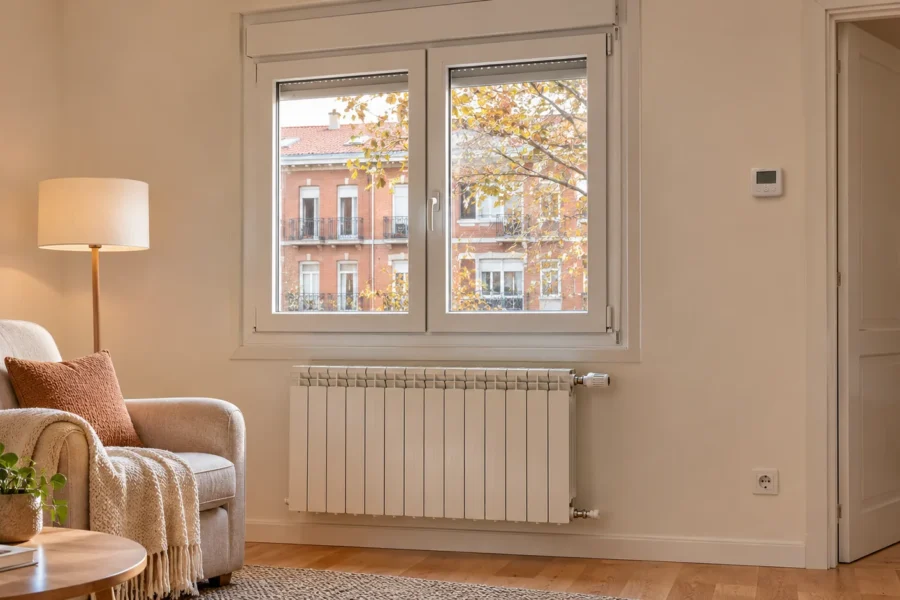
Yes, in some homes you can replace a gas or oil boiler with an air source heat pump and keep your existing radiators. Whether this works depends on their size, material and heat output, the water temperature required and your home’s heat losses. A technical assessment must establish whether every room will receive enough heat on cold days.
For homeowners in Madrid, three questions deserve separate answers: will it work, will it run efficiently, and will the investment make financial sense? Being able to heat the radiators does not automatically settle the other two.
How an air source heat pump works with radiators
An air-to-water heat pump extracts energy from the outdoor air and uses electricity to transfer that heat to the water in your heating circuit. Your radiators then release the heat into the rooms. In Spain, this technology is commonly called aerotermia.
Flow temperature means the temperature of the water supplied to the radiators. The smaller the temperature difference the heat pump needs to overcome between the outdoor air and the heated water, the more favourable its efficiency will generally be. The aim is therefore to keep the home comfortable with the lowest practical water temperature.
The limitation is radiator output: cooler water means less heat released. A radiator rated with water entering at 75°C and leaving at 65°C will not deliver that same output at 50/40°C. These are comparison conditions, not recommended settings for your home. The manufacturer’s correction data must be used.
Which existing radiators can you keep?
Aluminium radiators
These are lightweight and respond quickly. Many sectional models can be enlarged by adding elements, with changes to their connections. They can stay if their corrected output meets the room’s heating requirement. Being made of aluminium does not guarantee suitability for low-temperature operation.
Cast-iron radiators
Cast iron has greater thermal inertia: it takes longer to warm up and cool down. These radiators may be retained if they have sufficient heat-emitting surface and remain in good condition. Holding heat for longer does not increase their continuous heat output.
Steel and panel radiators
Output depends on dimensions, panel configuration and convector fins. Two similar-looking radiators can perform differently. The model should be identified, or its output assessed technically, alongside checks for corrosion and leaks.
Low-temperature radiators
These are designed to provide useful heat with cooler water, using a larger heat exchange surface and, in some models, fans. They support efficient heat pump operation but still need correct sizing. Not every model is suitable for cooling.
What determines whether your radiators are large enough?
- Room-by-room output: each room’s heat loss must be compared with its radiator’s output at the proposed operating temperatures.
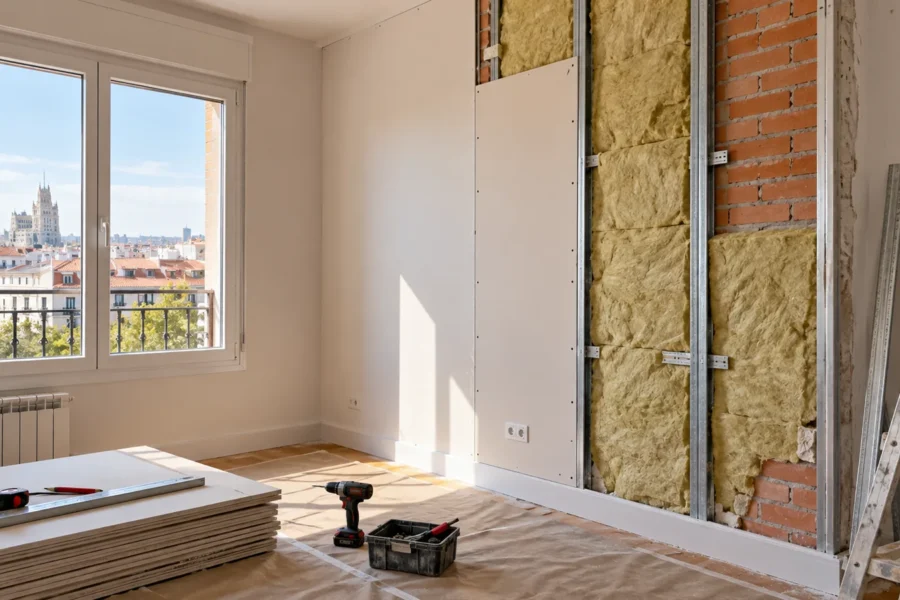
- Insulation: windows, walls, roofs, draughts and thermal bridges influence the heat your home needs.
- Size and layout: ceiling height, orientation, exposed rooms and occupied areas matter. Floor area alone is not enough to select a heat pump.
- Heating habits: maintaining steady comfort differs from rapidly warming up a cold property used only occasionally.
- Local climate: a sheltered central Madrid flat and an exposed detached house in the mountains require different assessments, particularly during cold spells.
- Heat pump performance: available capacity and efficiency must be checked at the relevant outdoor and water temperatures, rather than relying only on favourable catalogue conditions.
If your home loses heat quickly, consider improving wall insulation before choosing a larger heating system. Reducing demand may make it possible to retain radiators that would otherwise be insufficient.
Does a high-temperature heat pump solve the problem?
A high-temperature air source heat pump can make retaining existing radiators easier by producing hotter water. However, reaching a particular temperature is not the same as operating efficiently at that temperature. Check capacity, electricity use and the contribution of any electric backup heaters. A higher temperature also does not resolve inadequate water flow or poor heat distribution.
Your options if the existing radiators are insufficient
- Enlarge or add radiators: increase the heat-emitting surface where needed, after checking available space and the capacity of the pipework.
- Replace selected emitters: use low-temperature radiators or fan coil units. Fan coils incorporate a fan; cooling requires suitable pipe insulation, controls and condensate drainage.
- Improve insulation: reduce heat losses before increasing heating capacity.
- Consider underfloor heating: this may suit a renovation involving floors, door clearances and floor levels. Read our guide to underfloor heating in an existing Madrid flat.
- Assess a hybrid system: combine a heat pump and boiler where the calculations justify it, accounting for controls, maintenance and the costs of retaining both energy supplies.
Comparison: when can you keep your radiators?
| Situation | Can you keep the radiators? | Possible adjustments | Points to consider |
|---|---|---|---|
| Good insulation and adequate radiator output | Potentially all of them | System balancing and controls | Confirm output room by room. |
| Only some rooms lack sufficient output | Keep those that meet their room’s demand | Enlarge or replace selected radiators | A complete replacement may be unnecessary. |
| High heat losses and small radiators | Retention without improvements may be unsuitable | Insulation and greater emitter output | Assess running costs before selecting equipment. |
| Very hot water is routinely required | A detailed assessment is needed | High-temperature equipment, different emitters or a hybrid system | Compare efficiency and annual costs. |
| Full renovation with new flooring | Keeping them remains an option | Compare radiators with underfloor heating | Consider investment and the extent of building work. |
Benefits and limitations of retaining radiators
Reusing serviceable radiators and pipework can reduce demolition, waste and spending on new emitters. It can also help preserve existing finishes and the heating layout.
Limitations arise if the radiators require excessively hot water, contain sludge or restrict the necessary flow. Also, conventional radiators do not provide suitable summer cooling. Keeping them does not remove the electrical and hydraulic work involved in changing the heat source.
What the technical assessment should cover
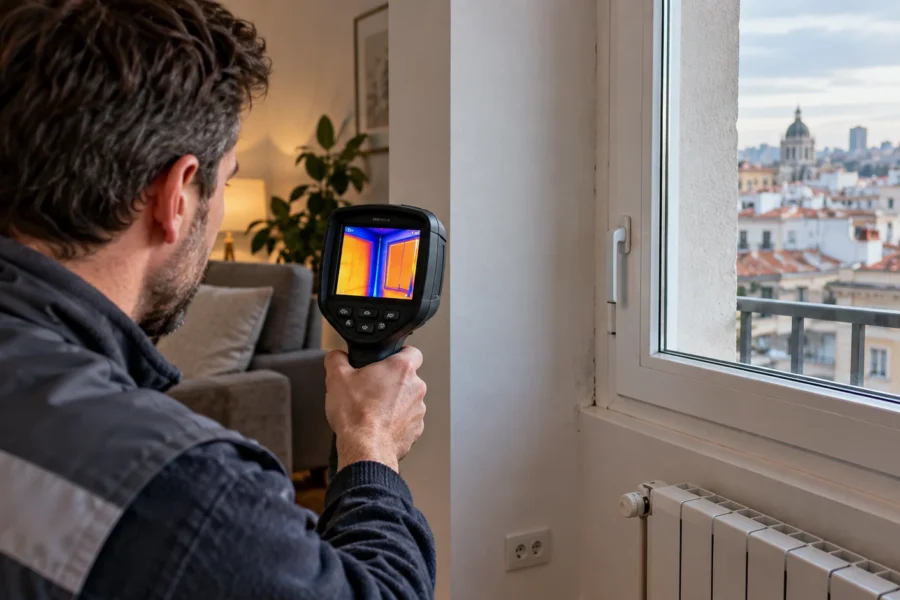
- Heat loss calculations: assess each room using the outdoor design conditions for the property’s location.
- Radiators and pipework: record the emitters, check their output at the proposed temperatures, and assess flow rates, balancing, cleaning and filtration.
- Equipment and controls: verify cold-weather capacity, seasonal efficiency, backup arrangements and weather-compensated flow temperature settings.
- Installation space: assess the outdoor unit’s position, airflow, noise, vibration, drainage, maintenance access and indoor space requirements.
- Electricity and hot water: check the supply, electrical protection and simultaneous loads; size hot water storage and recovery to suit occupants and habits.
The findings should compare retaining, adapting and replacing the emitters, with installation and estimated annual running costs calculated on consistent assumptions.
Permissions, grants and incentives in Madrid
The replacement must comply with Spain’s Regulation on Thermal Installations in Buildings (RITE), using an appropriately authorised installer and the required documentation. Check municipal procedures and the conditions for using or altering shared building elements, particularly façades and roofs.
Check current schemes with the Community of Madrid. As of 20 October 2026, its information page reports the closure of Programme 4 for energy efficiency improvements in homes. Older grant pages should not be treated as evidence that applications remain open.
The MITECO energy savings certificate catalogue (CAE) includes replacing combustion boilers with heat pumps. This is separate from a grant: any payment depends on eligibility and the terms for transferring the energy savings rights. There is no universally guaranteed amount.
Frequently asked questions
How much does replacing a boiler with a heat pump cost?
As a general commercial reference, Saunier Duval advertises installations starting at around €12,000. This is neither a Madrid price list nor a quotation for your property. Equipment, hot water provision, access, electrical work and radiator adaptations affect the cost. Request a clear scope and itemised VAT.
How much electricity will it use?
Consumption depends on heat demand, water temperature, weather, controls and backup heating. As an illustrative calculation, 6,000 kWh of annual heat demand divided by an assumed seasonal performance factor of 3 equals 2,000 kWh of electricity for that service. This is not a forecast for your home; hot water and other excluded consumption must be assessed separately.
Will it work during a Madrid winter?
Yes, with appropriate equipment selection and sizing. Cold weather can reduce efficiency and available capacity, and defrost cycles may be needed. The assessment must establish how the system will meet demand under those conditions.
Do all the radiators need replacing?
No. Enlarging or replacing radiators in selected rooms and balancing the circuit may be sufficient. A room-by-room calculation determines what is needed.
Can the heat pump also provide domestic hot water?
Yes, with equipment designed for domestic hot water and suitable storage. Do not assume an existing cylinder is compatible: its heat exchanger, recovery rate, space requirements and hygiene controls need checking.
Conclusion: assess the whole system before deciding
Keeping your radiators with an air source heat pump is viable when they meet each room’s heating requirement at water temperatures compatible with reasonable efficiency. If they do not, compare insulation improvements, emitter adaptations and alternative systems before committing.
Before replacing your boiler with a heat pump in Madrid, commission a professional heat loss and heating system assessment. Explore our heating and air conditioning services in Madrid or tell us about your property to discuss the next step.
Technical and official sources
- IDAE: heat pumps in building renovation, including radiator output and system sizing (Spanish).
- Daikin: compatibility with existing radiators (Spanish).
- BAXI: flow temperature and heating controls (Spanish).
Sources checked on 20 October 2026. The price reference is indicative; regulations, grant schemes and commercial conditions may change.