
Last updated: 23 August 2026.
When Should You Rewire an Apartment in Madrid?
You should consider rewiring an apartment when its electrical installation can no longer operate safely or support the way the property is currently used. Age alone does not make complete rewiring compulsory, but it is a reason to arrange a professional inspection. Important warning signs include:
- No effective protective earthing.
- An old fuse box or inadequate protective devices.
- Frequent tripping of RCDs or circuit breakers.
- Hot sockets, burning smells, buzzing or sparking.
- Deteriorated wiring or improvised alterations.
- New appliances that substantially increase electrical demand.
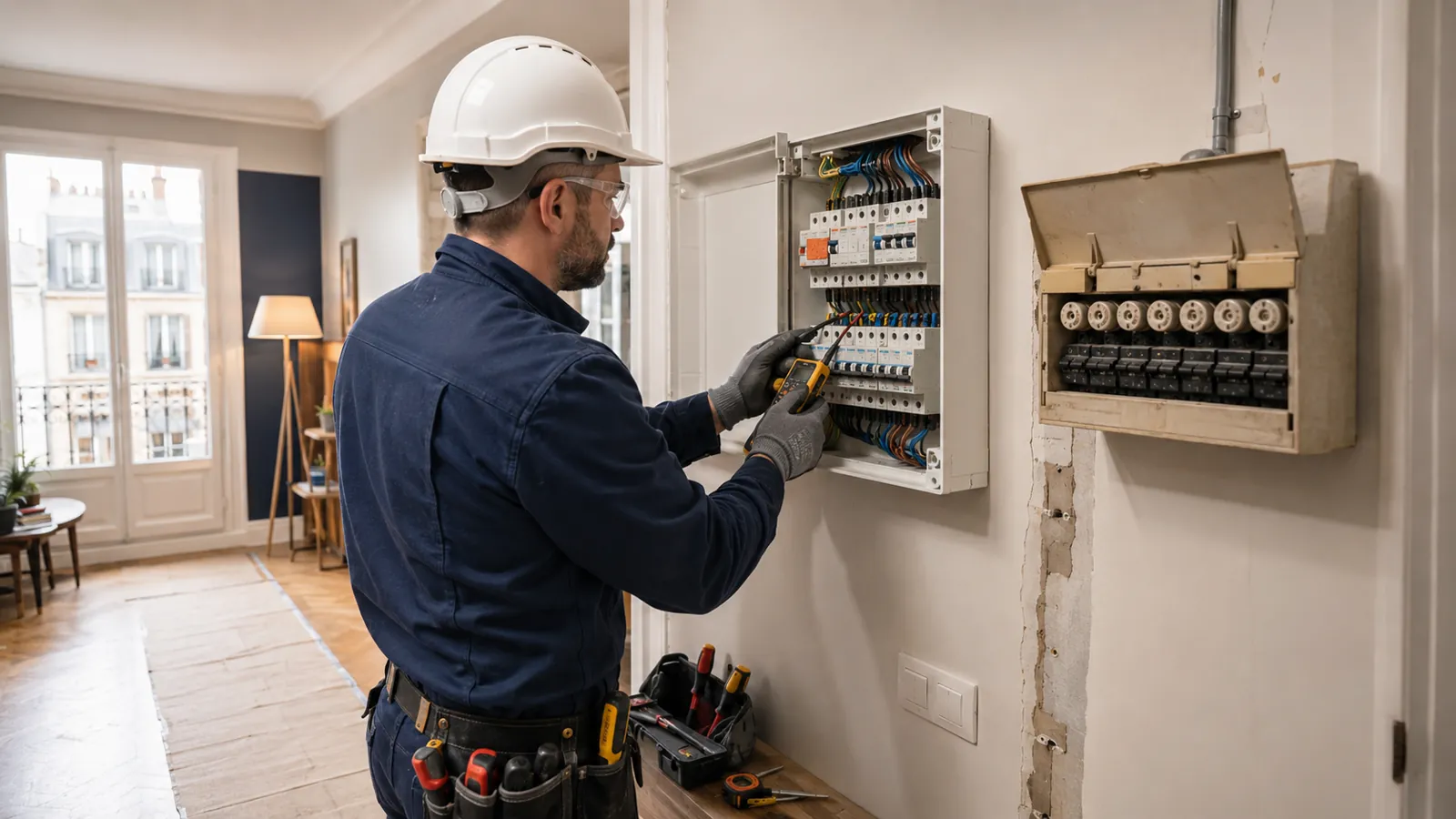
Warning signs that an apartment may need rewiring
There is no universal age at which every electrical installation must be replaced. Its condition depends on the materials, original workmanship, loads it has supported, later alterations, moisture, physical damage and maintenance.
In an older apartment, the age of the system should be assessed together with its protective devices, earthing, conductor insulation and ability to supply modern appliances safely.
1. The installation is several decades old
If the apartment was built before Spain’s current Low Voltage Electrotechnical Regulation came into force, or there is no reliable record of a complete electrical renovation, arranging an assessment is sensible before buying, renovating or introducing high-demand appliances.
Age should be treated as a reason to inspect, not as proof that every cable must automatically be replaced.
2. There is no effective protective earthing
Protective earthing—often called grounding in American English—helps carry fault current safely and works together with residual current protection.
A socket with an earth contact does not prove that it is connected to a continuous and effective earthing system. A registered installer should verify continuity, connection to the building’s earthing network and the relevant measurements.
3. The consumer unit contains fuses or inadequate protection
The consumer unit, also called an electrical panel, contains the devices that protect the apartment and its circuits. A current residential installation may include:
- Main circuit breaker: the Spanish IGA, protecting the installation against general overloads and short circuits.
- Residual current device: the RCD, known in Spanish as an interruptor diferencial, which disconnects the supply when certain leakage currents are detected.
- Miniature circuit breakers: MCBs, commonly called magnetotérmicos in Spain, protecting individual circuits against overloads and short circuits.
- Surge protection: protection against transient or permanent overvoltages where required.
An old fuse box, no RCD or a single circuit supplying most of the apartment are reasons to request a professional review.
Replacing only the consumer unit will not correct deteriorated wiring, missing protective conductors or undersized circuits elsewhere in the property.
4. The RCD or circuit breakers trip repeatedly
An isolated trip may be caused by a faulty appliance or a temporary overload. Repeated tripping requires investigation. Possible causes include leakage current, moisture, insulation failure, an overloaded circuit, an unsuitable protective device or defective equipment.
A circuit breaker must not be replaced with one of a higher rating unless the conductor size and characteristics have first been verified. Otherwise, the cable may no longer be adequately protected.
5. Sockets become hot, smell burnt, spark or show dark marks
Hot sockets, distorted covers, burning smells, persistent buzzing or scorch marks may indicate loose connections, overloads or internal damage. These symptoms require priority attention.
Replacing only the visible faceplate is not sufficient. The mechanism, connections, back box, conductors and circuit protection must be checked.
6. Sockets are damaged or there are too few outlets
Loose mechanisms, plugs that do not fit securely, unearthed outlets in altered rooms or permanent reliance on extension leads may indicate that the system no longer meets the property’s needs.
A shortage of outlets encourages users to connect too many appliances to the same socket or circuit.
7. Very old or damaged conductors are discovered
Textile-insulated cable, cracked rubber insulation, joints outside suitable boxes, unexplained changes in cable size or inconsistent conductor colours should be assessed by a professional.
Old cable may have no CE marking simply because it predates the relevant marking requirements. This can indicate age, but it is not a complete diagnosis by itself.
8. New high-demand appliances are being installed
Induction hobs, ovens, electric water heaters, heat pumps, air conditioning systems and electric vehicle chargers may require dedicated circuits, new protective devices or greater available capacity.
Replacing a gas hob with induction does not automatically require the whole apartment to be rewired. However, the circuit, conductor size, protective devices, consumer unit and expected electrical load must be suitable.
If the change is part of a wider project, see our kitchen renovation service in Madrid.
9. The installation has been affected by moisture or construction damage
Leaks, flooding, persistent damp or accidental drilling can damage conductors, sockets, junction boxes and protective devices. Affected components should not be returned to service until their condition has been checked.
10. There are improvised alterations
Warning signs include twisted cable joints, hidden connections outside accessible boxes, sockets supplied from unsuitable circuits, overcrowded conduit, unidentified circuits and exposed surface wiring without appropriate mechanical protection.
Full rewiring, partial upgrades or preventive maintenance?
| Approach | When it may be appropriate | Possible scope |
|---|---|---|
| Complete rewiring | Widespread obsolete or damaged wiring, no general earthing, an old fuse box, insufficient circuits, extensive defects or a full renovation with walls already being opened. | Consumer unit, circuits, conductors, conduits where necessary, boxes, sockets, switches, earthing, diagrams, testing and certification. |
| Partial electrical upgrade | Most of the installation is serviceable, but the consumer unit or specific circuits cannot support present requirements. | Protective-device upgrades and dedicated circuits for the kitchen, bathroom, water heater, air conditioning, terrace or electric vehicle charging. |
| Preventive maintenance | The installation is documented, properly protected, passes the relevant measurements and has no significant damage or alterations. | Testing, inspection of connections, RCD tests, damaged accessory replacement and circuit identification. |
Complete rewiring is often more practical when it forms part of a full apartment renovation in Madrid. Cable routes, sockets and lighting points can be coordinated before walls, ceilings and finishes are completed.
In an occupied apartment with a relatively recent and verified installation, a partial upgrade may reduce costs and disruption.
Electrical regulations applicable in Spain and Madrid
The Spanish Low Voltage Electrotechnical Regulation
The main national regulation is Royal Decree 842/2002 of 2 August, approving the Low Voltage Electrotechnical Regulation, normally referred to by its Spanish abbreviation, REBT.
It was published in the Spanish Official State Gazette—Boletín Oficial del Estado or BOE—on 18 September 2002 and came into force on 18 September 2003.
The consolidated text checked on 23 August 2026 states that its latest official update was published on 3 September 2025.
The most relevant Supplementary Technical Instructions—Instrucciones Técnicas Complementarias or ITCs—for an apartment include:
- ITC-BT-04: technical documentation and commissioning.
- ITC-BT-05: verification and regulatory inspections.
- ITC-BT-17: general and individual control and protection devices.
- ITC-BT-18: earthing systems.
- ITC-BT-19 to ITC-BT-24: internal installations, wiring systems and protective measures.
- ITC-BT-24: protection against direct and indirect contact.
- ITC-BT-25: the number and characteristics of residential circuits.
- ITC-BT-26: general installation requirements for homes.
- ITC-BT-27: rooms containing a bath or shower.
- ITC-BT-52: electric vehicle charging infrastructure.
The official consolidated regulations are published in Spanish. The English descriptions in this article are explanatory translations and do not replace the official wording.
Does an old installation have to be fully upgraded?
Not simply because it is old. Article 2 of the REBT states that, for installations predating the current regulation, its requirements apply to the part that is modified, repaired or extended. The necessary measures must also be taken to guarantee the safety of the installation as a whole.
The REBT may also apply to an existing installation where its condition presents a serious risk to people or property, or causes significant disturbance to other installations, as determined by the competent regional authority.
What counts as a major modification?
For documentation and initial-inspection purposes, the REBT classifies modifications or repairs affecting more than 50% of the installed power as major modifications.
This does not mean that work below that threshold is automatically exempt from testing or documentation. The registered installer must determine what procedure applies to the actual scope.
Situations that may require adaptation or new documentation
- Complete replacement of the apartment’s internal installation.
- A significant extension or alteration of the circuits.
- An increase in contracted power beyond the installation’s admissible capacity.
- Replacement of the consumer unit combined with substantial circuit changes.
- New dedicated circuits for induction, air conditioning or electric water heating.
- Installation of an electric vehicle charging point under ITC-BT-52.
- Modification of the supply installation, meter arrangement or individual supply line.
- Correction of conditions presenting a risk to people or property.
A consumer-unit replacement does not automatically require every cable to be changed. Equally, a new consumer unit should not be treated as proof that the remainder of the installation is safe without appropriate checks.
Apartment wiring, the individual supply line and communal systems
Before preparing a quotation, it is important to distinguish between three areas of the electrical system.
The apartment’s internal electrical installation
This generally includes the consumer unit, internal circuits, conductors, junction boxes, switches, sockets, lighting points and appliance connections inside the apartment.
The individual supply line
The Spanish term derivación individual refers to the line connecting the building’s meter installation to the control and protection devices serving an individual consumer.
Although it supplies one apartment, part of its route may pass through communal areas. Replacement may require assessment of its route, conductor size, conduit, meter arrangement and coordination with the owners’ association and the distribution network operator.
The building’s communal electrical systems
These may include the main supply line, central meter installation, communal earthing arrangements and electrical services used by the building.
Alterations may require approval or coordination with the community of owners—comunidad de propietarios—as well as technical documentation and distribution company involvement.
Rewiring the apartment will not automatically correct a defect in the communal system. The assessment must identify where the problem is located and who is responsible for authorising and carrying out each part.
Procedure for electrical work in the Madrid Region
-
Use a registered electrical installation company.
Regulated electrical work must be carried out and certified by an appropriately registered low-voltage installation company. The company can be checked using the official Madrid Region installer search service.
-
Arrange a site assessment and electrical testing.
The installer should assess the consumer unit, circuits, conductor sizes, protective-conductor continuity, insulation, RCD operation, earthing and expected electrical loads.
-
Define the technical scope.
The assessment should determine whether the installation needs repair, partial upgrading or complete rewiring. The quotation should distinguish electrical work from chasing, making good, painting, certification and any communal work.
-
Prepare a technical design memorandum or project.
Many ordinary residential installations are documented using a Technical Design Memorandum—Memoria Técnica de Diseño. Installations with certain characteristics, powers or special uses require a project prepared by a competent technical professional under ITC-BT-04.
-
Complete and verify the installation.
Before commissioning, the installation company must carry out the applicable regulatory verifications. These may include protective-conductor continuity, insulation resistance, earthing, RCD operation, polarity and protective-device checks.
-
Issue the Electrical Installation Certificate.
The Certificado de Instalación Eléctrica, abbreviated to CIE and commonly called the boletín eléctrico, records the characteristics of the completed installation and confirms that it has been verified by the registered installer.
-
Process commissioning or registration where required.
Low-voltage installations in Madrid are processed under the regional procedure and Order 9344/2003. Consult the Madrid Region’s official low-voltage installation commissioning and inspection procedure.
-
Request any increase in contracted power.
The account holder normally requests the change through the electricity retailer. The retailer communicates with the distribution network operator. If the requested power exceeds the installation’s admissible capacity, a new CIE, connection file or additional work may be required.
Documents worth keeping
- The accepted quotation and agreed scope.
- The Technical Design Memorandum or project, where applicable.
- The single-line diagram and circuit schedule.
- The Electrical Installation Certificate.
- Evidence of registration or processing where required.
- Test and measurement results.
- Information for the protective devices installed.
- Invoices identifying labour, materials and VAT.
- Photographs of conduit and cable routes before walls are closed.
When is an independent control body involved?
An ordinary individual apartment is not generally included among installations requiring periodic inspection by a Spanish control body.
ITC-BT-05 does require inspections for certain special installations and, every ten years, for communal electrical installations in residential buildings with total installed power above 100 kW. An inspection may also be required for electric vehicle charging installations that require a project.
In Madrid, it is useful to distinguish between:
- EICI: an industrial inspection and control entity that may participate in regional processing and registration.
- Control body: an organisation carrying out regulatory inspections where ITC-BT-05 requires them.
The installation company should confirm which procedure applies to the specific work.
Indicative rewiring costs and timescales in Madrid
The following figures are professional market estimates for 2026. They are not official tariffs or fixed quotations. Amounts include 21% VAT but must be confirmed after inspection and measurement.
| Work | Indicative cost | Typical installation time |
|---|---|---|
| Complete rewiring of a 60–90 m² apartment | €5,000–€10,000 | 5–10 working days |
| Consumer unit and protective-device upgrade | €650–€1,600 | Usually 1 day |
| Additional circuit for induction, water heating or air conditioning | €350–€1,100 per circuit | 1–2 days |
| Domestic electric vehicle charging point | €1,100–€3,000 | 1–3 installation days |
| Replacement individual supply line | From approximately €900; survey required | 1–3 days plus coordination |
A full-rewiring price may include the consumer unit, conductors, standard accessories, electrical labour and basic making good. The quotation should confirm whether final painting, decorative lighting, fees, project work, EICI processing, the individual supply line or communal works are included.
Factors affecting the cost
- Floor area, number of rooms and number of electrical points.
- Chased concealed wiring or surface-mounted trunking.
- Whether existing conduit can be reused safely.
- The condition of walls, ceilings and floors.
- The number of dedicated circuits.
- The selected range of switches and sockets.
- Making good, plastering and painting requirements.
- A new individual supply line or work to the meter installation.
- Long cable routes through stairs, courtyards or garages.
- Restricted access, working height or difficult material handling.
- Technical project, certification, fees or inspections.
- Coordination with the owners’ association and distribution company.
Indicative overall programme
| Stage | Indicative duration |
|---|---|
| Initial visit and assessment | 1–3 hours |
| Quotation and scope definition | 2–7 working days |
| Technical memorandum or project | 3–15 days, depending on complexity |
| Complete apartment rewiring | 5–10 working days |
| Testing and CIE | Approximately 1–5 days after completion |
| Power change without network work | Approximately 1–10 working days |
| Connection file involving supply or network work | Several weeks or longer |
Times controlled by the retailer, distribution company, owners’ association or public administration cannot be guaranteed by the renovation contractor.
Disruption to expect
- Planned interruptions to the electricity supply.
- Noise and dust where walls have to be chased.
- Protection or temporary removal of furniture.
- Opening and making good walls or ceilings.
- Access to the meter room.
- Coordination with neighbours for communal work.
Surface trunking can avoid much of the chasing, although it changes the appearance. Suspended ceilings and internal linings can also conceal routes when included in the overall renovation design.
Practical examples
A 1975 apartment with no earthing and an old fuse box
Indicative assessment: several important warning signs are present: obsolete protection, possible absence of protective conductors and circuits that may not support modern demand.
Recommendation: arrange a complete assessment and expect full rewiring to be a realistic possibility. If the building does not provide an adequate earthing network, the communal system must also be investigated with the owners’ association.
A 2005 apartment with RCD trips and a new induction hob
Indicative assessment: the age of the property does not justify complete rewiring. The tripping may be caused by an appliance, moisture, leakage current or an insulation fault.
Recommendation: locate the fault and verify the kitchen circuit and protective devices. If the rest of the installation passes the relevant tests, a partial upgrade may be sufficient.
A rented apartment with hot sockets
Indicative assessment: there may be a safety defect. The tenant should notify the landlord immediately using a method that creates a record.
Article 21 of Spain’s Urban Lettings Act—Ley de Arrendamientos Urbanos requires the landlord to carry out repairs necessary to keep the property habitable, unless the deterioration is attributable to the tenant.
Recommendation: the tenant should not commission a full renovation independently, except for justified urgent action under the legal conditions. The owner should be informed and authorisation obtained for non-urgent works.
Complete renovation versus targeted electrical work
If the kitchen, bathrooms, layout, flooring and decoration are all being renewed, it usually makes sense to assess the entire electrical installation before closing walls.
If the apartment is occupied, was rewired relatively recently and only needs to supply one additional appliance, a dedicated circuit and a targeted protection upgrade may be more proportionate.
Printable rewiring decision checklist
Mark yes or no. One positive answer does not prove that full rewiring is required, but several positive answers justify a professional assessment.
- ☐ Yes ☐ No — The installation is more than 30 years old and there is no record of complete rewiring.
- ☐ Yes ☐ No — The consumer unit contains fuses or has no RCD.
- ☐ Yes ☐ No — Protective earthing is absent or has not been verified.
- ☐ Yes ☐ No — The RCD or circuit breakers trip repeatedly.
- ☐ Yes ☐ No — Sockets become hot, spark, buzz or show dark marks.
- ☐ Yes ☐ No — There is a burning cable or plastic smell.
- ☐ Yes ☐ No — Sockets or switches are loose or damaged.
- ☐ Yes ☐ No — Extension leads are used permanently in several rooms.
- ☐ Yes ☐ No — There are visible joints or alterations of unknown origin.
- ☐ Yes ☐ No — Circuits are not identified at the consumer unit.
- ☐ Yes ☐ No — The property has suffered flooding, leaks or persistent damp.
- ☐ Yes ☐ No — Induction, electric water heating, heat pumps or air conditioning will be installed.
- ☐ Yes ☐ No — An electric vehicle charger is planned.
- ☐ Yes ☐ No — The contracted power needs to be increased.
- ☐ Yes ☐ No — The CIE is unavailable or the maximum admissible power is unknown.
- ☐ Yes ☐ No — A full renovation will involve opening walls or ceilings.
Practical priority: if you answered “yes” to overheating, burning smells, sparking or scorch marks, request an urgent professional review. If you answered “yes” to three or more of the remaining questions, arrange an assessment before renovating or increasing the power.
Electrical safety and good practice
- Do not remove consumer-unit covers or work inside sockets or junction boxes unless you are appropriately qualified and authorised.
- Electrical work must include safe isolation and professional verification that the circuit is not live.
- Do not improvise cable joints or conceal connections outside accessible boxes.
- Do not increase a circuit-breaker rating without verifying the wiring.
- Never disable an RCD because it keeps tripping.
- Residential additional protection commonly uses 30 mA RCDs under the REBT.
- Use the RCD’s TEST button periodically, following the manufacturer’s instructions.
- Do not assume that a socket earth contact is connected to an effective earthing system.
- Do not run high-demand appliances from multiway adapters or ordinary extension leads.
- Keep the consumer unit accessible and the circuits identified.
- Retain the CIE, diagrams, test information and invoices.
Common mistakes to avoid
- Replacing only the consumer unit without assessing the existing circuits.
- Preparing a quotation based only on the number of sockets.
- Increasing contracted power without checking the individual supply line.
- Connecting induction, water heating or air conditioning to unsuitable circuits.
- Covering junction boxes with furniture, tiles or inaccessible ceilings.
- Closing chases before tests and photographic documentation are completed.
- Using an unregistered person to obtain or issue the CIE.
- Assuming the apartment CIE certifies communal building systems outside its scope.
- Starting work in the meter room without permission and coordination.
Frequently asked questions
How long does electrical wiring normally last?
The REBT does not set a universal service life or require cable replacement at a particular age. Figures such as 25–40 years may be used as broad maintenance guidance, but they are not a legal replacement deadline. The decision should be based on inspection, measurements, insulation, temperature, loads, damage and installation conditions.
Are periodic electrical inspections compulsory in every Spanish apartment?
There is no general periodic inspection requirement applying to every ordinary individual home. ITC-BT-05 does require inspections for specified installations and for communal electrical installations in residential buildings with total installed power above 100 kW, which must be inspected every ten years.
What is the difference between an electricity retailer and a distributor?
The retailer—comercializadora—provides the tariff, invoices the customer and manages the supply contract. The distribution network operator—distribuidora—maintains the local network, handles metering and validates certain technical supply conditions. Consumers can choose their retailer but not the distributor assigned to their area.
What is the CIE or electrical bulletin?
The CIE is the Electrical Installation Certificate issued by a registered installation company after completing and verifying the installation. It records information such as the expected power and protective arrangements. It may be required for commissioning, certain modifications or power increases.
How do I calculate the right contracted power?
The assessment should consider appliances that may operate simultaneously, including induction, ovens, air conditioning, water heating, washing machines, dishwashers, dryers and vehicle charging.
It is not always appropriate simply to add every appliance’s maximum rating. Simultaneous use, load management and the installation’s maximum admissible capacity also matter.
What happens if the original building has no adequate earthing system?
An independent improvised earth must not be installed, and protective conductors must not be connected to water or gas pipes. A registered installer should assess the communal system and propose a compliant solution with the owners’ association.
Can an apartment be rewired without chasing the walls?
Sometimes. Surface trunking, conduit, suspended ceilings or wall linings can reduce chasing. Existing conduit may be reused if its condition, size, occupancy and route are suitable. Any visible or concealed solution must still comply with the REBT.
Must the whole apartment be rewired for an induction hob?
Not necessarily. The installer must check whether a suitable circuit exists, including its conductor size, protective devices, route, earthing and available power. If these are adequate, a partial alteration may be sufficient.
What to prepare before requesting an electrical assessment
Collect the following information before requesting a quotation:
- The building or apartment construction year.
- The approximate date of the last electrical renovation.
- The contracted power and CUPS supply code shown on an electricity bill.
- Clear photographs of the consumer unit without dismantling any protective cover.
- The number of rooms, bathrooms and approximate floor area.
- A list of high-demand appliances.
- Plans for induction, electric water heating, heat pumps, air conditioning or vehicle charging.
- The location of the meter and access arrangements for the meter room.
- Details of tripping, overheating, smells, moisture or damaged sockets.
- Any available CIE, drawings or electrical documentation.
A useful assessment should result in a clear diagnosis distinguishing:
- work required for safety;
- recommended improvements;
- optional alterations; and
- possible work outside the apartment.
Maceta y Cortafrío can assess and coordinate electrical work as part of a wider renovation, together with masonry, kitchens, climate control, plasterboard and finishes.
Explore our renovation services in Madrid, see our full renovation service or contact us to discuss your apartment.
Official sources
- Spanish Official State Gazette: Royal Decree 842/2002 and the Low Voltage Electrotechnical Regulation.
- Spanish Official State Gazette: consolidated REBT and Supplementary Technical Instructions.
- Spanish Official State Gazette: Royal Decree 1053/2014 and ITC-BT-52 on electric vehicle charging.
- Madrid Region: low-voltage installation commissioning and inspection procedure.
- Madrid Region: technical electrical documents.
- Madrid Region: registered installation and maintenance company search.
- Madrid Region: Order 9344/2003 of 1 October.
- i-DE: supply changes and contracted-power procedures.
- Spanish Official State Gazette: Urban Lettings Act.
Sources checked: 23 August 2026.
Article last reviewed: 23 August 2026.
This article provides general information and does not replace a site inspection, technical memorandum, project or certification prepared by appropriately qualified professionals. Costs and timescales are indicative and depend on the property, scope, materials, distribution company and any work required to communal systems.