Should You Complete a Full Renovation Before Selling in Madrid This Autumn?
Renovating a property before selling can make it more attractive, but it does not guarantee that every euro invested will be recovered. Autumn — particularly September to November — can bring renewed buyer activity after the summer, while also creating a demanding deadline for planning, construction and marketing. This guide explains when a full renovation may make commercial sense in Madrid, when a lighter refurbishment may be more appropriate and when selling the property in its current condition could be the safer decision.
Quick answer: three common situations
- Habitable but dated flat: consider decoration, repairs, lighting, professional cleaning and home staging before committing to a full renovation.
- Very dated flat in an area where buyers expect a move-in-ready home: assess a practical full renovation, but only if local comparable properties support the investment.
- Property with damp, structural concerns or complex approvals: obtain a technical assessment first. Rushing the work to meet an autumn sales date can increase delays and unexpected costs.
What “full renovation” normally means in Madrid
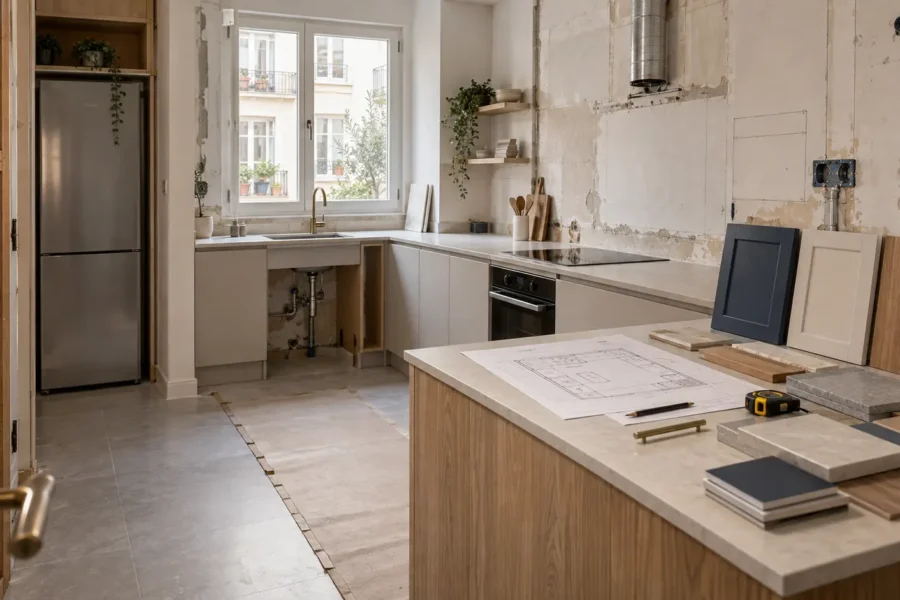
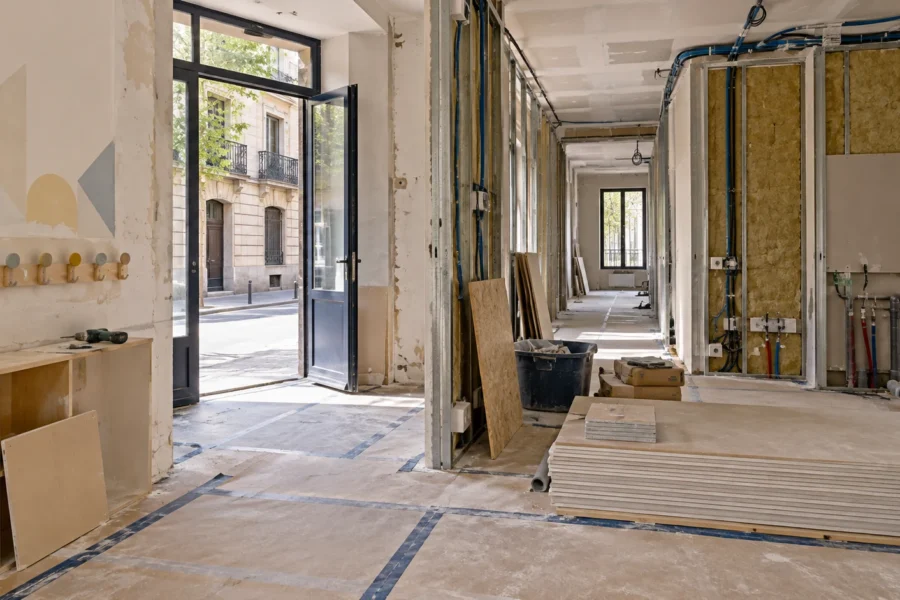
For a typical 70–100 m² apartment, a full renovation in Madrid may coordinate several work packages:
- Internal demolition and removal of existing finishes.
- Light layout changes using non-structural partitions.
- Electrical, plumbing and drainage upgrades.
- Kitchen and bathroom refurbishment.
- Flooring, tiling, decorating and interior joinery.
- Basic improvements to insulation, windows or climate control.
- Waste management, trade coordination and final snagging.
A quotation does not automatically include professional fees, municipal charges, furniture, appliances, windows, asbestos removal, structural reinforcement or work to communal parts of the building. These items must be identified explicitly. Our guide to what a renovation quotation should include explains how to compare scope, measurements, VAT, timings and exclusions.
Planning procedures, the owners’ association and working hours
International owners should be aware that a residential building in Spain is normally managed through a comunidad de propietarios, broadly equivalent to a condominium or homeowners’ association. Internal work must respect the building’s rules and communal elements, and the building representative or administrator should be informed before construction begins.
The correct municipal procedure depends on the exact work, the building’s protection status and whether the project affects structure, façade or communal services. Depending on the circumstances, work may require a declaración responsable urbanística — an urban planning responsible declaration — or a licence and technical documentation. The applicable route must be checked through the Madrid City Council Electronic Office [OFFICIAL SOURCE — SPANISH] or the relevant metropolitan municipality.
Under Spain’s Horizontal Property Act, owners can alter the interior of their property provided they do not compromise safety, the building structure, external appearance or the rights of other owners. Read the consolidated legislation in the Spanish Official State Gazette [OFFICIAL SOURCE — SPANISH].
In Madrid city, noisy work inside homes is generally restricted between 21:00 and 08:00 on working days and between 21:00 and 09:30 on Saturdays, Sundays and public holidays. Building rules may be more restrictive, so current municipal and community requirements should be confirmed before scheduling the work.
Does autumn make a difference to the Madrid property market?
Viewings often regain momentum after August, when buyers return from holiday and restart decisions postponed during the summer. Some also hope to complete before the end of the year. A finished, well-lit and move-in-ready home can therefore stand out against properties that require several months of building work.
There is, however, no guaranteed “autumn premium”. Mortgage conditions, available supply, neighbourhood, floor level, lift access, energy performance and the asking price usually matter more than the season itself.
What remains relevant in any year: compare genuinely similar renovated and unrenovated homes, calculate the full cost and define the target buyer. What must be updated for autumn 2026: buyer demand, financing conditions, competing listings, achievable prices and average marketing times. Portal data can be useful, but asking prices are not the same as completed sale prices.
Indicative renovation costs and potential return
As a preliminary professional estimate for 2026, a non-structural full renovation in Madrid may fall broadly within €900–€1,500 per m². This is not an official tariff or a fixed quotation. A tightly controlled project may cost less, while higher specifications, new windows, complex installations or climate-control systems can move the budget above this range.
- Complete kitchen: approximately €12,000–€28,000.
- Bathroom: approximately €6,000–€12,000 per room.
- Electrical and plumbing systems: highly dependent on the number of points, routes and condition of the existing services.
- Windows and energy upgrades: dependent on measurements, façade restrictions and the owners’ association.
The following figures are decision-making scenarios, not valuations or promises of resale value. The potential uplift must be tested against local evidence for the specific building and neighbourhood.
| Scenario | Estimated cost | Illustrative potential uplift | Indicative ROI | Break-even point |
|---|---|---|---|---|
| 75 m², functional full renovation | €67,500–€90,000 | €60,000–€105,000 | From negative to approximately +56% | The uplift equals all project costs |
| 95 m², functional full renovation | €85,500–€123,500 | €80,000–€140,000 | From negative to approximately +64% | The uplift equals all project costs |
| 75–95 m², cosmetic refurbishment | €12,000–€30,000 | €15,000–€40,000 | Highly dependent on the starting condition | The uplift covers the work and associated costs |
ROI can be expressed as: (estimated increase in sale price − total project cost) ÷ total project cost × 100. The calculation should also include additional months of service charges, utilities, finance, insurance and marketing.
Cost variations can arise from specification, hidden defects, lack of lift access, restricted waste removal, protected-building conditions, design changes, permits and material prices. When the objective is resale, our property renovation service for investors and owners in Madrid focuses on matching the scope to the intended commercial outcome.
Timescales: can the home be ready for an autumn listing?
- Survey, measurements and scope definition: 1–3 weeks.
- Quotation comparison and appointment: 2–4 weeks.
- Municipal procedure and technical documents: variable.
- Procurement and material delivery: 2–8 weeks, partly overlapping.
- Full renovation work: approximately 8–16 weeks.
- Snagging, cleaning, photography and staging: 1–3 weeks.
| Planning begins | Possible marketing window | Assessment |
|---|---|---|
| May–June 2026 | September–October | Potentially realistic if the scope is fixed |
| July 2026 | October–November | Tight; confirm lead times and availability |
| September 2026 | Late autumn or winter | Do not promise an autumn completion |
If the intended listing date falls between September and November, the safer approach is to have the survey, scope, quotation, administrative route and major material choices settled before the summer.
Advantages and risks of renovating before selling
Potential advantages
- Stronger first impressions in photography, listings and viewings.
- Access to buyers who want a move-in-ready property.
- Less uncertainty for buyers regarding old installations and repairs.
- More evidence to support the asking price and resist discounts.
- An opportunity to correct an inefficient layout.
Main risks
- Hidden defects and additional work discovered after demolition.
- Delays that cause the intended sales window to be missed.
- Choosing finishes that the eventual buyer does not value.
- Tying up cash without certainty of recovery.
- Creating a final asking price above the neighbourhood ceiling.
Alternatives to a full renovation
| Alternative | Relative cost | Likely effect | Indicative time |
|---|---|---|---|
| Cosmetic refurbishment | Low–medium | Strong visual improvement | 1–4 weeks |
| Critical repairs | Variable | Reduces objections and discounts | 1–6 weeks |
| Targeted energy improvements | Medium | Can improve comfort and performance | 2–8 weeks |
| Home staging | Low–medium | Improves photography and viewings | 1–2 weeks |
| Sell as “in need of renovation” with plans | Low | Helps buyers understand the potential | 1–3 weeks |
A cosmetic package might include neutral decoration, minor repairs, updated switches, better lighting, deep cleaning and selected kitchen or bathroom improvements. In many cases, this can deliver a better balance between investment and presentation than replacing everything.
Any proposed layouts or computer-generated images should be labelled as conceptual visualisations. They do not replace technical design or confirm that a proposed layout is legally or technically feasible.
Signs that a full renovation may — or may not — be worthwhile
It may be worth considering when
- The property is significantly dated and competes directly with renovated homes.
- The local buyer profile places a high value on move-in-ready accommodation.
- The kitchen, bathrooms, installations or layout create clear sales objections.
- The supported difference between current and renovated value exceeds the full cost by a sensible margin.
- You have sufficient time, liquidity and contingency funds.
It may not be worthwhile when
- You need to sell within a few weeks.
- The work depends on uncertain licences or community approvals.
- Structural or communal-building problems remain unresolved.
- The renovated asking price would exceed what the area normally supports.
- The target buyer is likely to want a personalised design.
Key legal and technical points
Confirm the municipal procedure, protected-building status, community requirements and any occupation of public space before work begins. Construction and demolition waste must be handled through appropriate channels under Royal Decree 105/2008 [OFFICIAL SOURCE — SPANISH] and the applicable regional and municipal rules.
Depending on the work, the project may require a qualified designer, technical report, site supervision or health and safety coordination. Contracts should define the scope, exclusions, materials, VAT, payment schedule, insurance, variations and guarantees.
An energy performance certificate is generally required when a home is sold in Spain, subject to the applicable exceptions. Renovation may improve the rating, but the result must be assessed and certified by a competent professional. See Royal Decree 390/2021 [OFFICIAL SOURCE — SPANISH] and the Institute for Energy Diversification and Saving, IDAE [OFFICIAL SOURCE].
Technical notice: requirements and timescales should be confirmed with the relevant town hall, building administrator and appropriately qualified professionals. The Madrid Institute of Architects, COAM [OFFICIAL SOURCE] provides professional and institutional information.
Final recommendation: decision matrix
| Seller profile | Recommended approach | Next step |
|---|---|---|
| Wants to maximise price and has 4–6 months | Assess a functional full renovation | Compare current value, renovated value and complete cost |
| Wants a balance between time and investment | Partial refurbishment and staging | Prioritise repairs, decoration, lighting, kitchen and bathrooms |
| Needs to sell urgently | Sell in the current condition with strong presentation | Correct critical defects and price against the market |
The right decision is not to renovate automatically. It is to invest only when the property can absorb the cost, risk and delay. Before committing funds, compare the likely sale price in both conditions and allow a contingency margin.
What to do before deciding
- Request two or three genuinely comparable, itemised quotations.
- Arrange a technical visit to identify ageing installations and hidden defects.
- Obtain an assessment of the current property and a reasoned post-renovation estimate.
- Include indirect costs, taxes and the additional holding period.
- Prepare professional photography, floor plans and a virtual tour, with or without renovation.
Planning to sell a property in Madrid this autumn? Maceta y Cortafrío can review the condition of the property, the available programme and the work packages most relevant to the sale. We will help define a proportionate scope without promising a market uplift that cannot be guaranteed.
Frequently asked questions
How much does it cost to renovate an 80 m² flat in Madrid?
As an initial estimate, a non-structural full renovation might range from approximately €72,000 to €120,000. The actual price depends on services, layout, specification, windows, access, permits and unforeseen work.
Does renovation always increase the sale price?
No. It may improve marketability and value, but the return depends on the starting condition, location, target buyer and final cost.
Can I start in September and sell before December?
A limited refurbishment may be possible. A full renovation would have a tight programme and should not be confirmed before checking permissions, procurement, contractor availability and technical complexity.
Which improvements usually help a sale most?
Repairs, neutral decoration, lighting, flooring, cleaning, presentation, kitchens and bathrooms often influence perception. The correct priorities depend on the individual property.
Is it better to sell the flat as “in need of renovation”?
It can be, particularly when the sale is urgent, approvals are complex or buyers are likely to want their own layout and finishes. Accurate plans and clearly labelled conceptual visuals can help explain the potential.