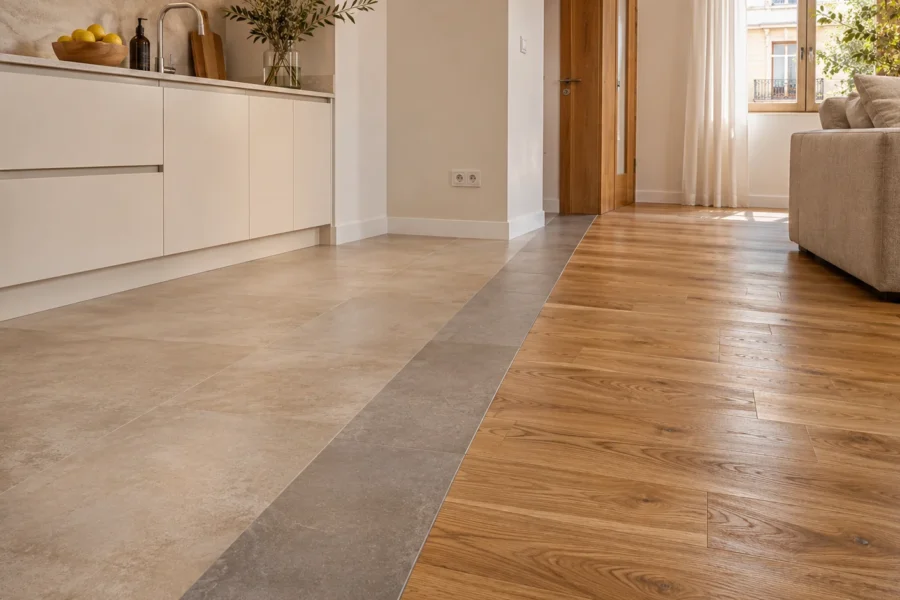
Choosing microcement or porcelain tiles in the shower affects more than the appearance of your bathroom. It determines the preparation work, junction details, maintenance and how future damage can be repaired. Make this decision before agreeing the budget for wall and floor finishes, comparing complete systems rather than a finish sample with the price of a box of tiles.
How the two finishes look
Microcement creates a visually continuous surface without a grid of grout lines. Its texture and tonal variations reflect the hand-applied finish, so approve a sample first. A seamless appearance does not mean eliminating movement joints required by the underlying construction.
Porcelain tiles offer a wide choice of sizes, colours and stone, concrete or wood effects. Joints remain part of the design, even with rectified tiles, which have precisely finished edges. Larger formats reduce the number of joints but may require additional cuts around corners, drains and changes in floor slope.
What both systems need underneath
Neither microcement nor porcelain tiles, on their own, replace the shower’s waterproofing system. A tile with low water absorption does not make its junctions watertight. A continuous finish does not automatically resolve pipe penetrations or movement either.
Specify a compatible system protecting the floor and walls exposed to water, with reinforced corners and a watertight connection to the drain. For microcement, the waterproofing build-up must be approved for that finish: a membrane designed for tiling is not necessarily suitable for a continuous coating applied directly over it.
- Substrate: the supporting surface must be sound, clean and even, with acceptable moisture levels and no loose areas. Investigate cracks before covering them.
- Installation: microcement requires the specified primer, layers and protective finish. Porcelain needs compatible adhesive, proper adhesive coverage and grouting.
- Critical details: wall-to-floor junctions, corners, niches, shower fitting penetrations, flexible sealant joints and the drain connection.
- Falls: the floor must slope towards the drain without leaving puddles. A thin decorative coating cannot correct inadequate drainage slopes.
If you want a level-access shower in a Madrid flat, check the depth available for drainage and waterproofing too.
A practical comparison
| Criterion | Microcement | Porcelain tiles | What it means for the homeowner |
|---|---|---|---|
| Appearance | Continuous, with hand-applied tonal variations. | Extensive choice, with visible joints. | Approve samples and the layout before committing. |
| Supporting surface | Movement can show through the finish. | An unstable base can cause cracking or debonding. | Neither option makes a defective base acceptable. |
| Water and stains | Performance depends on the formulation and protective finish. | Low water absorption; joints need attention. | Request performance information for the specific product. |
| Impact and wear | Can scratch, chip or lose its protective layer. | Generally durable, but impacts can chip edges. | Neither surface is indestructible. |
| Cleaning | No intermediate grout lines, but incompatible cleaners can damage it. | Easy-care surface; texture and joints affect cleaning effort. | Consider who will clean the shower and how. |
| Repairs | A patch may differ in colour or texture. | A damaged tile can potentially be replaced with a spare. | Decide how acceptable a visible repair would be. |
| Time and thickness | Thin finish, with successive drying stages. | Tile thickness plus adhesive and underlying layers. | A thin finish does not mean immediate use. |
Slip resistance: check the actual floor finish
“Matt” and “slip-resistant” are not interchangeable. Ask for the classification and test evidence for the exact finish in wet, barefoot conditions. With microcement, this means the system including its final sealer.
Spain’s CTE DB-SUA assigns Class 3 to showers within the scope of its slip-resistance section. However, that section does not list private residential dwellings, or Residencial Vivienda, among the uses covered. Do not automatically apply that requirement to every domestic bathroom, or treat a tiled shower floor as equivalent to a prefabricated tray. The designer must check the use, location and applicable requirements. R ratings, A/B/C classifications and CTE classes cannot simply be substituted for one another.
Everyday maintenance
A useful routine is to rinse away soap after use, remove excess water and ventilate. Cleaning frequency depends on use and limescale build-up: there is no universal schedule. Deposits can accumulate on either finish, while mould can develop on dirt and persistently damp sealant.
- Microcement: use a compatible pH-neutral cleaner and soft cleaning tools. Avoid abrasive pads, solvents and acidic limescale removers unless expressly approved by the manufacturer. Some systems tolerate other products, but this cannot be assumed.
- Porcelain: use a compatible cleaner and rinse thoroughly. Textured slip-resistant surfaces may need gentle brushing. Avoid hydrofluoric acid and products that damage grout, trims or fittings.
- Sealant joints: look for cracking, separation and loss of adhesion, and replace deteriorated sealant. Cementitious or epoxy grout does not replace a flexible movement joint.
Microcement may need its protective coating renewed when the manufacturer advises or wear becomes apparent. There is no fixed renewal interval for every system. Standard porcelain usually needs no renewed varnish, although grout and specific surface treatments may require attention. Aggressive cleaners can alter colours or damage components in either installation.
Repairs and service life
A crack needs investigation to establish whether it originates in the supporting surface. Covering it without addressing the cause may allow it to return. Chipped microcement can be repaired, but matching colour, texture and sheen is not always possible. Refinishing a complete wall or floor section may give a more consistent result.
A broken porcelain tile can be replaced, taking care not to damage the waterproofing. Keep spare tiles with the same product reference, shade and calibre—the manufacturer’s actual size grouping. If the range is discontinued and no spares remain, a larger area may need replacing. Damaged grout can be renewed locally if the base is sound.
Leaks require checks of the plumbing, waterproofing and junctions: adding silicone does not always address the cause. Either system may need opening up. A universal lifespan would be misleading: preparation, specialist workmanship, use and maintenance matter as much as the material.
What does the complete system cost in Spain?
Price reference: 9 November 2026. Topciment publishes €80–130/m² for installed microcement, without specifying VAT treatment in that table. BuildGets lists porcelain wall tiling at €56–72/m² in direct construction costs, excluding contractor overheads, profit and VAT. These are not complete shower prices or directly equivalent figures.
The following table provides our indicative planning estimates, excluding VAT, informed by those references and the work required. It is not a published supplier breakdown or a quotation following inspection. It assumes a straightforward layout and mid-range finishes.
| Item | Microcement | Porcelain tiles |
|---|---|---|
| Preparation and minor surface levelling | €10–25 | €10–25 |
| Compatible waterproofing and reinforcement | €25–45 | €25–45 |
| Finish and application, including protective coating | €80–120 combined | €20–45 for tiles |
| Tile installation and adhesive | Included above | €35–45 |
| Finishing details, joints and flexible sealant | €5–10 | €5–10 |
| Surface-work subtotal | €120–200/m² | €95–170/m² |
Add items priced per shower: forming the falls and supplying and connecting the drain are estimated at €250–450 for a straightforward shower, without relocating the waste pipe. For new construction with an already prepared base, completed levelling work should not be charged again. For refurbishment involving removal, allow an estimated €20–40/m² for stripping the existing finish and removing waste. Substantial rebuilding is assessed separately.
Example: a 120 × 80 cm shower
Three walls, each 2.30 m high: (1.20 + 0.80 + 0.80) × 2.30 = 6.44 m². Floor: 0.96 m². Total finished area: 7.40 m², without niches.
- Microcement: 7.40 × €170 + €350 for falls and drainage = €1,608 excluding VAT.
- Porcelain: 7.40 × €135 + €350 = €1,349 excluding VAT.
- Including removal: adding 7.40 × €30 = €222 brings the totals to €1,830 and €1,571 excluding VAT, respectively.
These are worked examples, not commercial quotations. They include the layers and finishing details described, but exclude the screen, shower fittings, plumbing alterations, hidden damage and statutory fees. Applicable Spanish VAT, known as IVA, is added separately. Minimum charges for travel and execution can increase the totals, particularly when commissioning the shower alone.
The base condition, location and access, niches, corners, tile layout, large formats, drain choice and finish expectations also affect cost. If covering existing tiles is proposed, first check when tiling over bathroom tiles is appropriate. Compare quotations using the same itemised scope.
Before appointing a contractor
Ask for the proposed system and product references, an approved sample, slip-resistance details, junction specifications, a watertightness check before covering and the required waiting time before use. Request cleaning and repair instructions too. Maceta y Cortafrío can assess your bathroom renovation in Madrid so you can compare both options on the same basis.
Sources and references
- Spain’s CTE DB-SUA with commentary: slip resistance and scope.
- Schlüter-KERDI: waterproofing, junctions and drainage.
- Topciment: the role of the sealer and published 2026 prices.
- Resistone: substrates, application and maintenance.
- TAU Cerámica: installation and cleaning guidance.
- BuildGets: 2026 wall-tiling cost database.
Quick decision guide
- A seamless appearance: choose microcement if you accept hand-applied variations and maintenance of its protective finish.
- Minimal maintenance: choose easy-clean porcelain, while still looking after grout and sealant.
- Localised repairs: porcelain with spare tiles is usually more straightforward; a microcement patch may remain visible.
- A tight budget: compare manageable porcelain formats and a simple layout. Large-format tiles can change the cost comparison.
- Limited thickness or a quick refurbishment: consider microcement over a suitable base, without confusing a thin finish with immediate readiness for use.
- A rental property or intensive use: porcelain usually simplifies upkeep; microcement can work when its specific care requirements can be maintained.