Can you install a commercial kitchen in premises without an existing smoke extraction system in Madrid? In some circumstances, yes. However, the feasibility depends on the proposed business activity, cooking equipment, emissions, building characteristics, local regulations and any restrictions imposed by the owners’ association.
For property investors and hospitality operators, the main risk is not simply a more expensive renovation. It is purchasing or leasing premises that cannot legally or technically accommodate the intended restaurant, café or takeaway business.
Before signing a purchase agreement or commercial lease, it is essential to establish the property’s technical, planning, legal and financial feasibility.
1. What Is a Smoke Extraction System?
A commercial kitchen extraction system captures and removes emissions generated during food preparation. Depending on the installation, it may include an extraction canopy, grease filters, ductwork, mechanical fans and fire protection components.
Three concepts must be distinguished:
- General ventilation: replaces indoor air to maintain appropriate environmental conditions.
- Kitchen extraction: captures cooking fumes, steam, grease particles and odours.
- Discharge to the façade or roof: determines where extracted emissions are released and under which conditions.
An existing ventilation shaft is not necessarily suitable for commercial kitchen extraction. Similarly, an opening onto the street does not automatically permit kitchen fumes to be discharged through the building’s façade.
Before investing: request drawings of the existing installations and ask a qualified professional to assess whether they can accommodate the proposed activity.
2. The Type of Food Business Determines Extraction Requirements
Not every food business generates the same level of smoke, grease, steam or odours. The equipment, cooking processes and intensity of use must be established before assessing extraction requirements.
Café With Limited Food Preparation
A café serving drinks, pre-prepared products and food requiring only limited heating may have different extraction requirements from a full-service restaurant.
Nevertheless, even relatively simple food preparation can generate emissions that require appropriate ventilation or extraction.
Restaurant With a Full Commercial Kitchen
Griddles, fryers, grills and other professional cooking appliances can produce significant quantities of grease, smoke and odours.
For these businesses, the design of the extraction and discharge system can become one of the most important factors determining whether the premises are suitable.
Takeaway or Delivery-Only Kitchen
Operating without a dining area does not remove the need to comply with kitchen extraction requirements.
A delivery-only kitchen may generate emissions comparable to those of a conventional restaurant, depending on the cooking processes involved.
The decisive factor is what happens in the kitchen, not whether customers eat on the premises.
3. What Regulations Apply in Madrid?
The applicable requirements depend on the municipality in which the premises are located.
Madrid City Council regulations do not automatically apply to other municipalities in the Community of Madrid, such as Pozuelo de Alarcón, Alcobendas, Las Rozas or Majadahonda.
Premises Located Within Madrid City
Madrid City Council’s Ordinance 4/2021 on Air Quality and Sustainability (Ordenanza 4/2021 de Calidad del Aire y Sostenibilidad) contains provisions relating to cooking activities and the extraction and discharge of emissions.
Articles 23 and 24 address relevant technical conditions and certain exceptional circumstances. Their current wording and applicability must be checked for each project.
Official source: Madrid City Council.
Other considerations may include:
- Planning compatibility and permitted commercial uses.
- Environmental and noise regulations.
- Fire safety requirements.
- Building health and ventilation standards.
- Accessibility requirements.
- Heritage protection or special planning restrictions.
- Specific limitations affecting the surrounding area or building.
Premises in Other Municipalities
If the property is located outside Madrid city, the relevant municipal planning rules, environmental ordinances and administrative procedures must be checked with the appropriate local council.
National and regional legislation may also apply, including the Spanish Technical Building Code (Código Técnico de la Edificación, or CTE), industrial safety regulations and applicable fire protection requirements.
Official reference: Royal Decree 314/2006 — Spanish Technical Building Code.
Activity Licence or Responsible Declaration
Depending on the business, location and proposed works, the administrative procedure may involve a licence or a declaración responsable, commonly translated as a responsible declaration.
A responsible declaration is a formal statement that the applicable requirements are met. It is not an exemption from those requirements and does not prevent subsequent inspections or enforcement action.
The appropriate procedure must be established before renovation work or commercial operations begin.
4. Why the Owners’ Association Matters
Even if a ventilation engineer identifies a technically feasible route for an extraction duct, installing it may require legal authorisation.
Many commercial premises occupy the ground floor of residential buildings. Extraction ducts may need to pass through internal courtyards, external façades, shared shafts or communal roofs.
Before committing to the property, examine:
- The building’s title deeds and constitutive documents.
- The owners’ association’s statutes (estatutos de la comunidad).
- Relevant resolutions recorded in meeting minutes.
- Whether the affected areas are private or communal property.
- Existing rights relating to ducts and service installations.
- Whether specific authorisation is required for the proposed works.
Spain’s Horizontal Property Law (Ley de Propiedad Horizontal) provides the general legal framework governing private and communal elements in buildings with multiple owners.
Official reference: Law 49/1960 — Horizontal Property Law.
A landlord’s verbal assurance that the community will approve an extraction duct should not be treated as sufficient evidence.
Investment risk: a technically viable kitchen may still be impossible to install if the necessary rights or permissions cannot be obtained.
5. Technical Inspection: What Must Be Checked?
A professional site inspection can reveal substantial obstacles that are not visible in property advertisements or commercial floor plans.
Possible Duct Route to Roof Level
A qualified professional should determine whether a practical extraction route exists and whether it can be constructed safely.
The assessment should consider duct dimensions, changes of direction, structural penetrations, discharge location, maintenance access and the position of nearby windows and air intakes.
Required dimensions and clearances must be calculated according to the applicable standards and installation design, rather than assumed.
Space for Extraction Canopies and Filters
The kitchen layout must provide adequate space for the necessary extraction equipment.
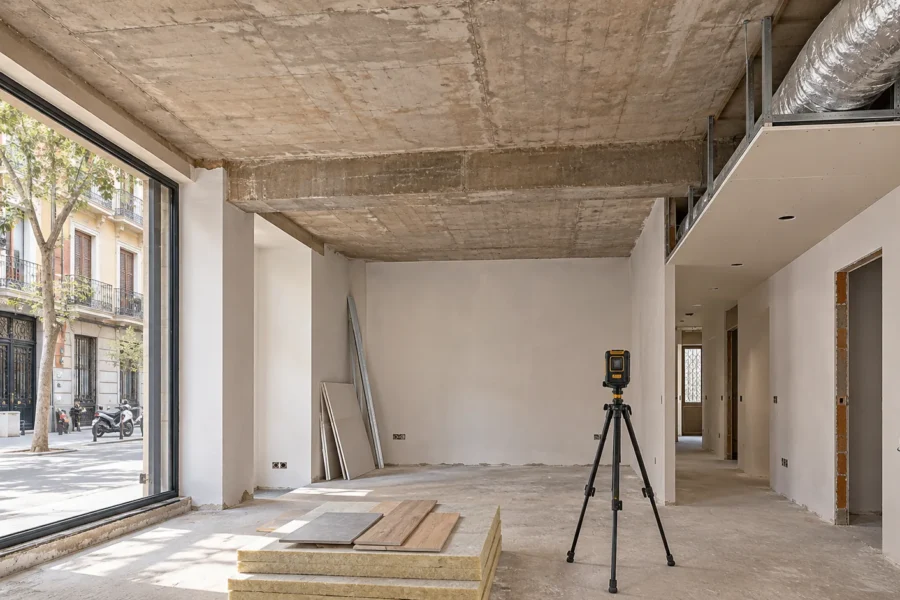
Structural beams, low ceilings, existing services and restricted access can complicate installation and increase costs.
Electrical Supply, Gas and Ventilation
Check the available electrical capacity, distribution boards, potential supply upgrades and any gas installation requirements.
Commercial kitchens may also require a properly designed replacement air supply to balance extracted air.
Fire Safety, Noise and Maintenance
The project must consider applicable fire protection requirements, appropriate duct construction, grease management and access for cleaning and inspection.
Mechanical extraction systems may also require acoustic treatment to prevent unacceptable noise affecting neighbouring properties.
Poorly designed systems can lead to operational problems, complaints, additional maintenance expenses and regulatory difficulties.
6. Alternatives When Conventional Smoke Extraction Is Not Feasible
When installing a conventional duct to roof level is impractical, alternative cooking equipment and business models may be worth investigating.
However, none of these options automatically eliminates legal extraction requirements or guarantees administrative approval.
Electric Cooking Equipment
Electric appliances avoid combustion emissions produced by gas burners at the point of use. Nevertheless, cooking with electricity can still generate smoke, grease, steam and odours.
Low-Emission Cooking Methods
Some food preparation processes generate fewer emissions than conventional frying or grilling. A business model based on these processes may offer different technical possibilities.
Filtration and Air Treatment Systems
Depending on the application, specialist systems may incorporate grease filtration, activated carbon or other air treatment technologies.
The suitability of these systems must be demonstrated for the specific equipment, emissions and regulatory framework.
Business Models With Limited On-Site Cooking
Operators may consider concepts involving pre-prepared products, limited reheating or reduced cooking intensity.
This decision should be based on both regulatory feasibility and the commercial viability of the revised business model.
Within Madrid city, Article 24 of Ordinance 4/2021 provides for certain exceptions subject to specific conditions. It must not be interpreted as general permission to operate any kitchen without roof-level extraction.
7. Documents to Request Before Buying or Leasing
Before signing a commercial property agreement, request the available documentation from the seller or landlord.
- Previous activity licences and responsible declarations.
- Existing architectural and installation drawings.
- Technical projects and certificates.
- Electrical, gas and ventilation documentation.
- Owners’ association statutes and relevant meeting resolutions.
- Information concerning existing extraction ducts.
- Previous activity records and relevant administrative proceedings.
- Available inspection reports and technical assessments.
An old restaurant licence may provide useful background information, but it does not necessarily authorise a new operator, different activity or modified installation.
Likewise, an existing extraction duct should not be assumed to comply with current requirements without professional verification.
8. Hidden Costs That Can Affect Investment Returns
The cost of adapting premises for a commercial kitchen extends far beyond purchasing extraction equipment.
Potential additional expenses include:
- Technical studies and professional fees.
- Administrative procedures and applicable charges.
- New extraction ductwork and roof penetrations.
- Scaffolding and access equipment.
- Works affecting communal building elements.
- Electrical supply upgrades.
- Fire protection measures.
- Acoustic insulation and odour treatment.
- Accessibility improvements.
- Changes to the internal layout.
- Cleaning and ongoing extraction maintenance.
- Rent, finance charges and operating expenses before opening.
Operating hours and environmental restrictions may also affect the commercial potential of the business.
Financial recommendation: assess the total investment required to make the premises operational, including contingency allowances and pre-opening expenses.
A low purchase price or attractive monthly rent does not necessarily mean the premises represent a good investment.
9. Which Professionals Should You Consult?
Before making a binding financial commitment, several parties may need to be involved.
- Qualified architect or engineer: planning compatibility, technical feasibility, regulatory requirements and project design.
- Relevant town or city council: permitted uses, applicable administrative procedures and local requirements.
- Owners’ association: rights and permissions affecting communal elements.
- Specialist installers: practical extraction, ventilation and electrical installation options.
- Legal adviser: contractual protection, property rights and necessary authorisations.
A renovation contractor can help assess construction requirements, estimate the scope of works and coordinate the implementation phase with the appropriate professionals.
At Maceta y Cortafrío, we work on property renovations in Madrid, including the adaptation of commercial premises.
10. Frequently Asked Questions
Can I Open a Café Without Smoke Extraction in Madrid?
It may be possible depending on the food preparation processes, equipment, building and applicable regulations. A café with limited cooking may have different requirements from a restaurant with a full commercial kitchen.
A specific technical and regulatory assessment is still necessary.
Does Using Electric Cooking Equipment Remove the Need for Extraction?
Not automatically. Electric cooking equipment can still generate grease, steam, smoke and odours requiring appropriate extraction or treatment.
Can a Kitchen Extraction Duct Discharge Through the Façade?
This cannot be assumed. The applicable municipal rules, discharge conditions, building characteristics, potential effects on neighbouring properties and required permissions must all be considered.
If the Premises Previously Operated as a Restaurant, Can I Reopen Them?
A previous restaurant activity is useful evidence, but it does not guarantee that a new business can operate under the same conditions.
The administrative status, proposed activity, installations and current requirements must be checked.
Who Authorises an Extraction Duct Through a Communal Courtyard?
The answer depends on property rights, the building’s constitutive documents, owners’ association statutes and the nature of the proposed works.
Legal advice may be necessary before proceeding.
What Should I Do Before Signing a Commercial Lease?
Arrange a preliminary technical and planning feasibility assessment, review the available property documentation and negotiate contractual provisions that protect your investment if the intended activity cannot proceed.
11. Pre-Investment Checklist
- ☐ Define the intended business activity and cooking equipment.
- ☐ Confirm planning compatibility.
- ☐ Identify the applicable municipal regulations.
- ☐ Establish the required administrative procedure.
- ☐ Assess kitchen extraction and emission discharge options.
- ☐ Review communal property rights and necessary authorisations.
- ☐ Inspect electrical, ventilation and fire safety installations.
- ☐ Check accessibility, noise and environmental requirements.
- ☐ Obtain existing licences, drawings and technical records.
- ☐ Estimate total renovation and installation costs.
- ☐ Include financial contingencies and potential delays.
- ☐ Make the purchase or lease conditional on technical and administrative feasibility.
Before Investing, Make Sure the Premises Can Accommodate Your Business
A well-located commercial unit with attractive rental terms can become a costly mistake if it cannot accommodate the kitchen required for the intended activity.
The safest approach is to make the purchase or lease conditional on confirming technical, planning and administrative feasibility, including the legal rights required to install the necessary systems.
At Maceta y Cortafrío, we can help you assess the construction requirements of adapting commercial premises in Madrid and coordinate a preliminary technical evaluation with the appropriate professionals.
Contact Maceta y Cortafrío to discuss your commercial renovation project in Madrid.
Important: This article is for general information only. It does not replace a project-specific technical feasibility study or legal advice. All regulatory references must be checked against their current versions and the requirements applicable to the particular municipality, building and business activity.